

In the coming weeks and months, I'll be sharing the results of my students' 'reflection reports': a creative assignment in any format they wished, that reflected on one or more aspects of English Literature (Taylor's Version). To kick off, please enjoy this absolutely incredible Taylorfied version of monopoly. The board itself is fantastic, but even better are the Chance and Community Chest cards, which are packed full of witty references to all the books and poems we covered during the course. [Click above image to see more].

English Literature (Taylor’s Version): Seminar 9
I had been looking forward to teaching this class for months. In some ways, it's the class that started it all: my concrete idea for English Literature (Taylor's Version) took shape when listening to 'The Great War' for the first time back in 2022, and noticing parallels with Sylvia Plath's poem 'Daddy' (you can read more about that here). It eventually grew into something bigger: a seminar that paired trauma studies with discussion of art as therapy, the connections between literature, love and war, and close reading of Geoffrey Chaucer's Troilus and Criseyde, John Donne's 'Love's War' and, of course, Plath's 'Daddy'. We also discussed Holocaust literature, the disturbing trend for '...of Auschwitz' titles in modern publishing, and what it means to use art to talk about trauma. It was, perhaps, the most meaningful seminar of all those I've taught, and sparked perhaps the most important conversations. [Click above image to read more]

Argylle and the Author function
The end of this month will see the release of the film Argylle, directed and produced by Matthew Vaughn. It’s a spy thriller based on a debut novel by American author Elly Conway. So far, so normal. However, when you find out that the film rights were purchased by Apple in 2021 for $200 million, years before the novel was even released, and that there are no pictures of, or interviews with, Elly Conway available online, despite her instagram account having over 40,000 followers, things start to look a little strange. As anyone who knows anything about publishing will tell you, Apple do not pay millions of dollars for the film rights to as-yet-unpublished debut novels by nobodies, and if you want to publish any book these days, good luck to you if you’re not willing to take every chance for self-promotion that you can, including plastering your face all over social media. Who the hell, then, is Elly Conway?

Speak now? Aviation, activism and accountability
The other day, I received an email. It went straight into the special folder of my inbox where any emails containing the keyword ‘Swift’ are automatically programmed to go; this is my desperate attempt to try and maintain some compartmentalisation of my professional life, since I do actually also have to maintain a normal full-time workload on top of repeatedly telling the media why All Too Well (10 minute version) is a masterpiece (which, don’t get me wrong, I love to do, because it is).
English Literature (Taylor’s Version): Seminar 8
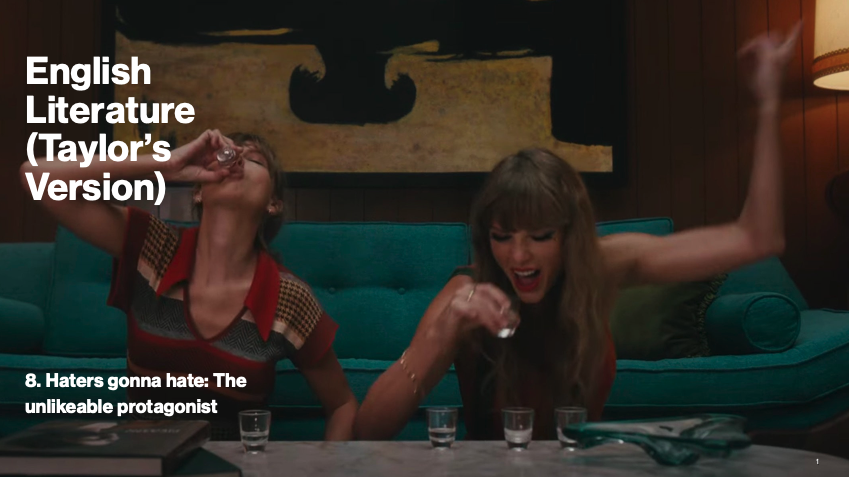
In Seminar 8 of English Literature (Taylor's Version), titled 'Haters Gonna Hate: The Unlikeable Protagonist', we looked at the antihero, or deliberately unlikeable protagonist, in literature and culture. We tried to answer the question: what does it mean for Swift to self-identify as an antihero, in the twenty-first century? In order to do this, we looked at groundbreaking incarnations of the antihero in William Makepeace Thackeray’s Vanity Fair (1848) - subtitled 'A novel without a hero' - and Charlotte Bronte’s Villette (1853). [Click above image to read more]

English Literature (Taylor’s Version): Seminar 7
[by Kristel Tole; this seminar was led by Zoe van Cauwenberg]. In seminar 7, we started out with an analysis of three songs from Taylor Swift's repertoire: Mastermind, Nothing New, and Castles Crumbling. My group talked about 'Mastermind' and we answered three questions. First: How do these songs engage with questions of fame, legacy and reputation? Taylor in her song 'Mastermind' shows the desire she has for wanting to be with the person that she loves. She tries hard to get with this person showing no fear of what the public thinks. She doesn’t question her fame or her reputation because she is in love and wants to be with her lover. She challenges the societal norms of what a woman should be in a relationship, not to be a pawn but a fighter. It is this force that drives her to not give up. [Click the above image to read more]

English Literature (Taylor’s Version) in numbers
What a semester it's been! Click above the image for more vital stats from our English Literature (Taylor's Version) classroom.

English Literature (Taylor’s Version): Seminar 6
[By Paulien Vercruysse] In seminar 6 of English Literature (Taylor’s Version), we focused on Romanticism, nature and ecocriticism, alongside Taylor Swift’s music. No less than five songs were on the agenda for this week and not one of them was unwelcome. The songs that we put under the microscope were ‘New Romantics’, ‘Out of the Woods’, ‘The Lakes’, ‘Ivy’ and ‘Willow’. The seminar was kicked off with a discussion of the songs. We tried to uncover what they were about, what role nature plays in them, and what striking images and oppositions we stumbled upon. [Click above image for more]
English Literature (Taylor’s Version): Seminar 5
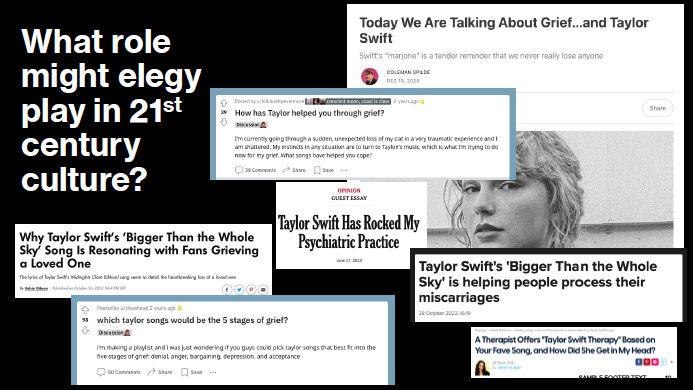
In seminar 5, we explored the relationship between Swift's music ('Soon You'll Get Better'; 'Ronan'; 'Marjorie'; 'You're Losing Me'; 'Bigger Than the Whole Sky') and elegy, a capacious term that usually connotes a song or poem about death or bereavement, the tradition for which originated in ancient Greece. We looked at three very different examples of elegies: the anonymous 'The Wanderer', from the tenth century (originally written in Old English); Thomas Gray's 'Elegy Written in a Country Churchyard' from the eighteenth century; and Christina Rossetti's 'A Dirge' (nineteenth century). Focusing on these poems, we explored the relationship between language, memory and emotion. Later, we asked what role elegy might play in twenty-first-century culture, and looked at some of the fan responses to Swift's elegies, speculating that these might help to remove some of the taboos surrounding grief, death and bereavement and enable people to articulate their emotions in a cathartic and restorative way. [Click above image for notes]

Title Pages (Taylor’s Version)
This is why we can have nice things; or, what happens when students are tasked with making an eighteenth-century-style title page for a Taylor Swift song. [Click above image to see more]
 Swifterature