
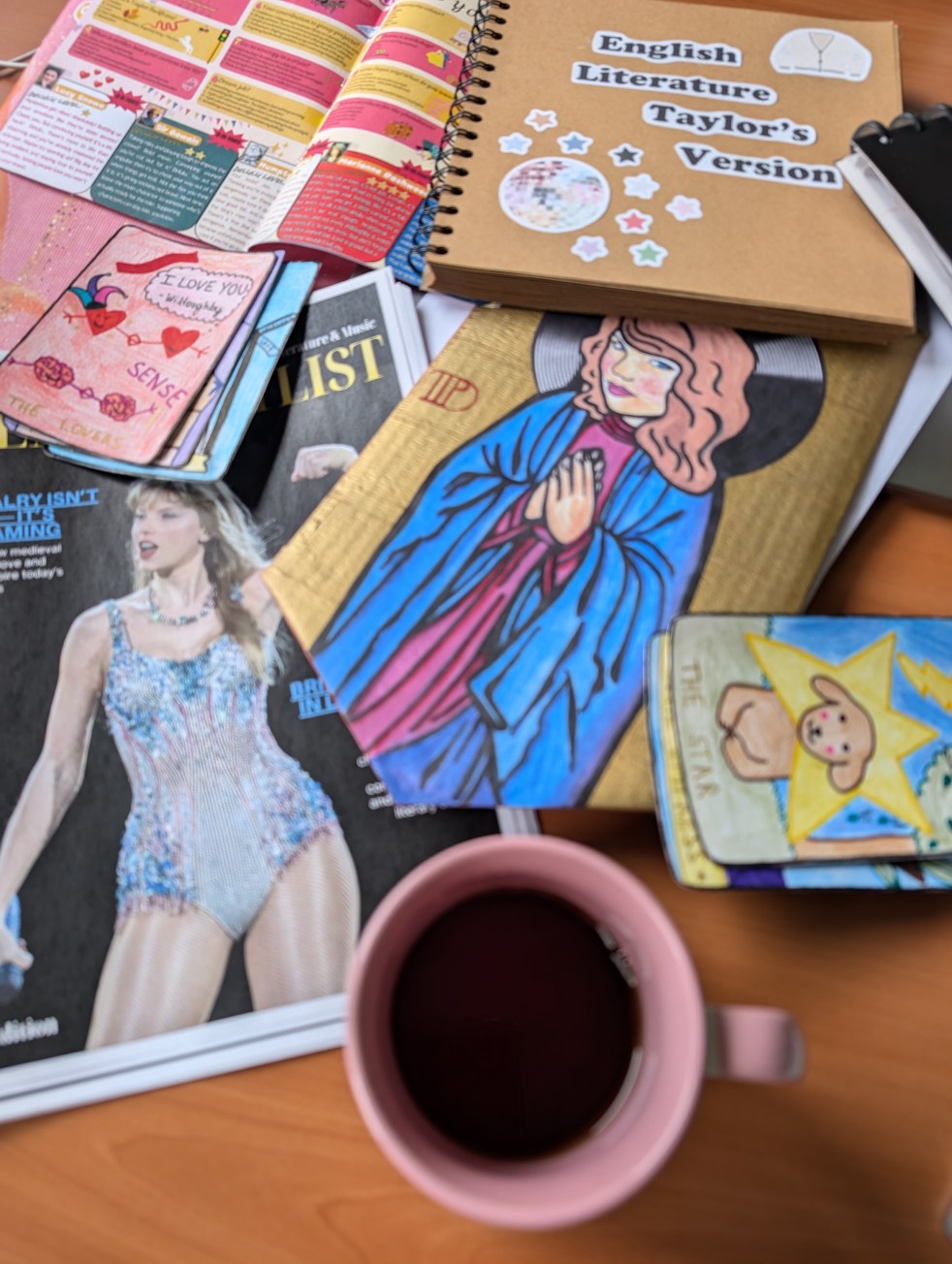
As part of their final assignment for English Literature (Taylor's Version) - my Masters course at Ghent University - students have to prepare a 'reflection report'. This can take any form, and should be inspired by one or more aspects of the ten-week course. The results are endlessly creative, inspiring, and moving. I've shared a… Continue reading Creative reflections on English Literature (Taylor’s Version)
Category: teaching

On being, and not being, The Man: modern-day vindications of gender rights
As preparation for one of our seminars in English Literature (Taylor's Version) — in which we look at connections between writing, gender, and power, focusing on Taylor Swift's 'The Man', 'mad woman', 'Dear John', 'Hits Different', and 'the last great american dynasty' — I ask students to write a modern-day version of 'A Vindication of… Continue reading On being, and not being, The Man: modern-day vindications of gender rights
Why do we need feminism? Thoughts from English Literature (Taylor’s Version)
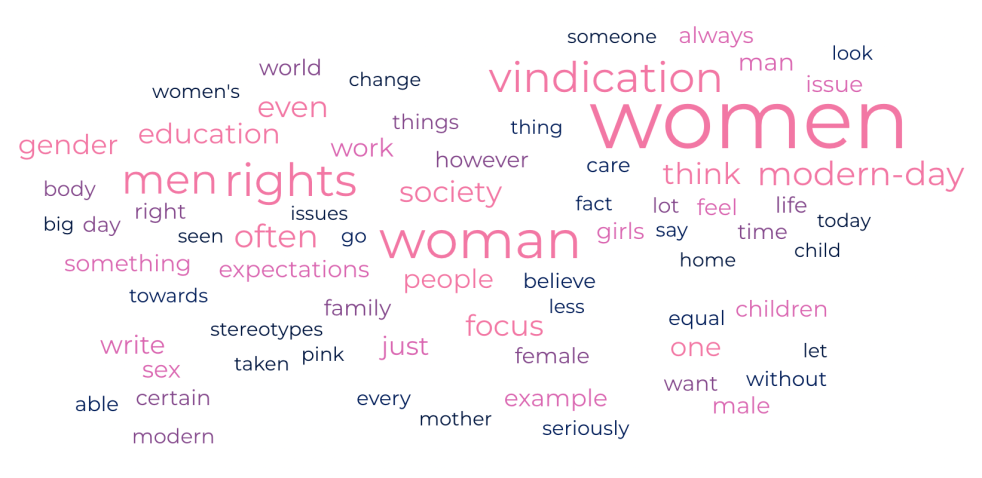
As part of our session on feminism, writing and power, we looked at Mary Wollstonecraft's seminal 'Vindication of the Rights of Woman', a 1792 treatise that argued for the importance of women's education during a period where it was habitually denied. Expected to be little more than delicate parlour ornaments, women were not seen as worthy recipients of the kind of education offered to men - a state of affairs which Wollstonecraft laments, while pointing out its idiocy (surely men would prefer a wife with whom they can hold a conversation). As a thought experiment, I asked my students: 'If you could write a modern-day "Vindication of the Rights of Woman", what feminist - or gender-related - issue would you focus on, and why?' Here are some of the responses - you can also see a word cloud of the most frequently used terms above. Click on it to read more.

English Literature (Taylor’s Version): Seminar 9
I had been looking forward to teaching this class for months. In some ways, it's the class that started it all: my concrete idea for English Literature (Taylor's Version) took shape when listening to 'The Great War' for the first time back in 2022, and noticing parallels with Sylvia Plath's poem 'Daddy' (you can read more about that here). It eventually grew into something bigger: a seminar that paired trauma studies with discussion of art as therapy, the connections between literature, love and war, and close reading of Geoffrey Chaucer's Troilus and Criseyde, John Donne's 'Love's War' and, of course, Plath's 'Daddy'. We also discussed Holocaust literature, the disturbing trend for '...of Auschwitz' titles in modern publishing, and what it means to use art to talk about trauma. It was, perhaps, the most meaningful seminar of all those I've taught, and sparked perhaps the most important conversations. [Click above image to read more]
English Literature (Taylor’s Version): Seminar 8
In Seminar 8 of English Literature (Taylor's Version), titled 'Haters Gonna Hate: The Unlikeable Protagonist', we looked at the antihero, or deliberately unlikeable protagonist, in literature and culture. We tried to answer the question: what does it mean for Swift to self-identify as an antihero, in the twenty-first century? In order to do this, we looked at groundbreaking incarnations of the antihero in William Makepeace Thackeray’s Vanity Fair (1848) - subtitled 'A novel without a hero' - and Charlotte Bronte’s Villette (1853). [Click above image to read more]

English Literature (Taylor’s Version): Seminar 7
[by Kristel Tole; this seminar was led by Zoe van Cauwenberg]. In seminar 7, we started out with an analysis of three songs from Taylor Swift's repertoire: Mastermind, Nothing New, and Castles Crumbling. My group talked about 'Mastermind' and we answered three questions. First: How do these songs engage with questions of fame, legacy and reputation? Taylor in her song 'Mastermind' shows the desire she has for wanting to be with the person that she loves. She tries hard to get with this person showing no fear of what the public thinks. She doesn’t question her fame or her reputation because she is in love and wants to be with her lover. She challenges the societal norms of what a woman should be in a relationship, not to be a pawn but a fighter. It is this force that drives her to not give up. [Click the above image to read more]

English Literature (Taylor’s Version) in numbers
What a semester it's been! Click above the image for more vital stats from our English Literature (Taylor's Version) classroom.

English Literature (Taylor’s Version): Seminar 6
[By Paulien Vercruysse] In seminar 6 of English Literature (Taylor’s Version), we focused on Romanticism, nature and ecocriticism, alongside Taylor Swift’s music. No less than five songs were on the agenda for this week and not one of them was unwelcome. The songs that we put under the microscope were ‘New Romantics’, ‘Out of the Woods’, ‘The Lakes’, ‘Ivy’ and ‘Willow’. The seminar was kicked off with a discussion of the songs. We tried to uncover what they were about, what role nature plays in them, and what striking images and oppositions we stumbled upon. [Click above image for more]
English Literature (Taylor’s Version): Seminar 5
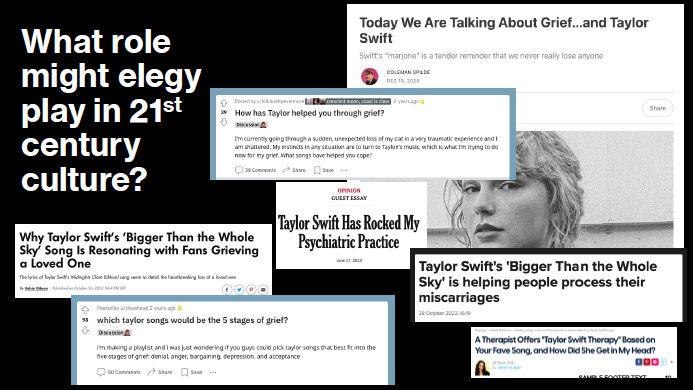
In seminar 5, we explored the relationship between Swift's music ('Soon You'll Get Better'; 'Ronan'; 'Marjorie'; 'You're Losing Me'; 'Bigger Than the Whole Sky') and elegy, a capacious term that usually connotes a song or poem about death or bereavement, the tradition for which originated in ancient Greece. We looked at three very different examples of elegies: the anonymous 'The Wanderer', from the tenth century (originally written in Old English); Thomas Gray's 'Elegy Written in a Country Churchyard' from the eighteenth century; and Christina Rossetti's 'A Dirge' (nineteenth century). Focusing on these poems, we explored the relationship between language, memory and emotion. Later, we asked what role elegy might play in twenty-first-century culture, and looked at some of the fan responses to Swift's elegies, speculating that these might help to remove some of the taboos surrounding grief, death and bereavement and enable people to articulate their emotions in a cathartic and restorative way. [Click above image for notes]

English Literature (Taylor’s Version): Seminar 4
In Seminar 4 of English Literature (Taylor's Version), we looked at the relationship between writing, gender and power, asking what Taylor Swift can teach us about literary feminism. We listened to 'Right Where You Left Me', 'Dear John', 'Mad Woman', 'Hits Different' and 'The Man', asking: What construction(s) of femininity do we see in the song? What is the relationship between writing and power? Are there any literary allusions? Is this a 'feminist' song? if so, why? If not, why not? We used this discussion - also bringing in Swift's re-recording of her masters, seen by many as a feminist act - to segue into two important feminist literary texts: Mary Wollstonecraft's 'Vindication of the Rights of Woman' (1792) and Charlotte Perkins Gilman's The Yellow Wallpaper (1892). [Click above image to read more]
 Swifterature