
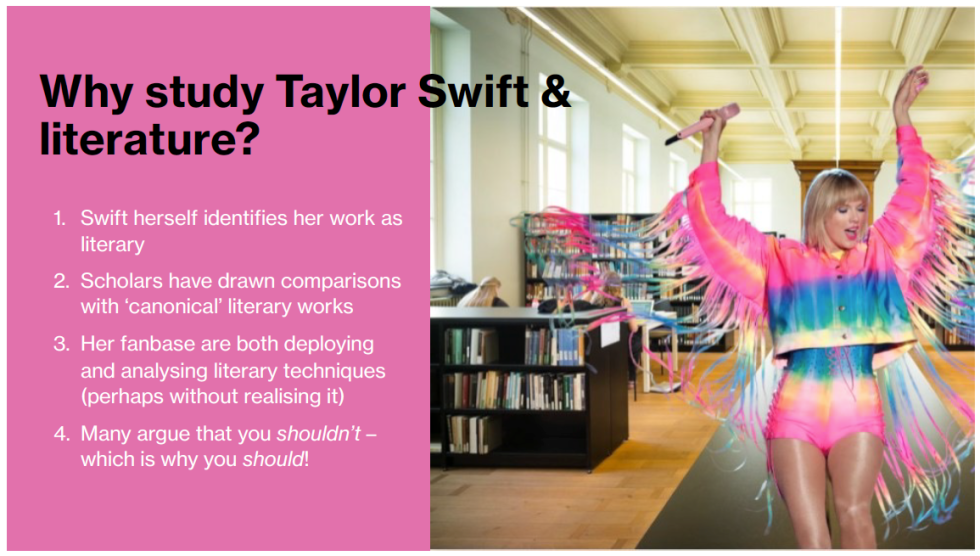
In the first seminar of English Literature (Taylor’s Version) at Ghent University, we looked at four reasons to study Taylor Swift’s work alongside English literature.
1. Swift herself identifies a particularly literary quality in her work. In her recent speech at the Nashville Songwriting Awards, she divided her lyrics into three categories based on the type of pen that best suits their composition: quill, fountain pen, and glitter gel pen. The former is particularly revealing:
“I categorize certain songs of mine in the Quill style if the words and phrasings are antiquated, if I was inspired to write it after reading Charlotte Brontë or after watching a movie where everyone is wearing poet shirts and corsets. If my lyrics sound like a letter written by Emily Dickinson’s great grandmother while sewing a lace curtain, that’s me writing in the Quill genre.”
Swift thus consciously situates herself within a literary landscape and acknowledges the enmeshment of her work within a complex web of intertextuality. It makes sense, then, to pay closer attention to this web, both for how it can illuminate Swift’s own work, and for what it suggests about the thriving and varied afterlives of historical literary texts. As literary critics Andrew Bennett and Nicholas Royle argue, ‘literature […] is a monstrous or mutant form, a mutant discourse. Literary texts don’t appear out of nowhere,’ nor should they be fetishised as static ‘monuments’ and left to gather dust.
2. In his article ‘Why Taylor Swift is a Literary Giant’ for the Sydney Morning Herald, esteemed scholar Jonathan Bate compared Swift favourably alongside Shakespeare and the Romantic poets. He is certainly not the first scholar to identify the academic potential of studying Swift’s work alongside more ‘serious’ material – there are already several Swift-themed university courses in America, ranging from music to psychology – and in 2024 a series of universities in Australia will host the first international academic conference on Swift (a Swiftposium, if you will). The very fact that such attention seems to ‘legitimise’ Swift’s work for some audiences raises larger questions of literary value, judgement, gatekeeping and institutionalisation: who gets to decide what is and is not ‘literary giant’ material? Does the academic interrogation of certain material automatically assign it societal value? Why do scholars keep returning to the Swift-Shakespeare comparison, and what does this tell us about the canon? These are all questions we will explore in English Literature (Taylor’s Version), and they will hopefully lead to bigger, challenging questions about the subjectivity of cultural value (see point 4).
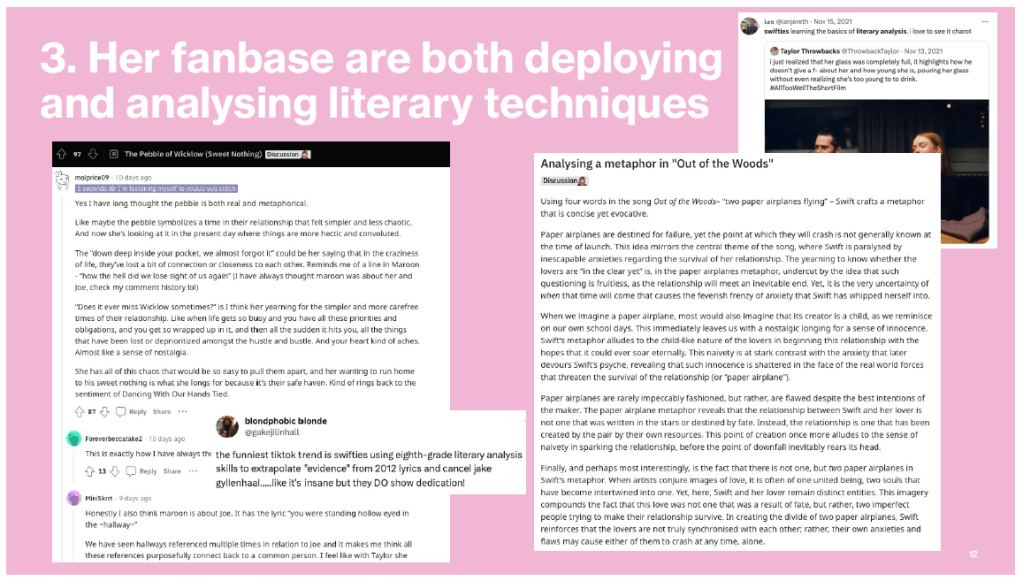
3. A quick glance at the Swiftie community on platforms such as Reddit reveals a coterie of dedicated literary critics, devoted to close reading Swift’s lyrics in a manner we might expect from students of the sonnet. There are in-depth analyses of everything from the paper aeroplanes flying in ‘Out of the Woods’ to the symbolism of the pebble in ‘Sweet Nothing’. The fact that Swift’s work, perhaps more than any other artist, attracts this kind of forensic close reading certainly suggests that we should sit up and pay attention. It implies that the fusion of traditional literary criticism and scholarship with modern popular culture can be a productive arena, and suggests the potential for said culture to liberate the kind of critical thinking we tend to confine mostly to an academic arena.
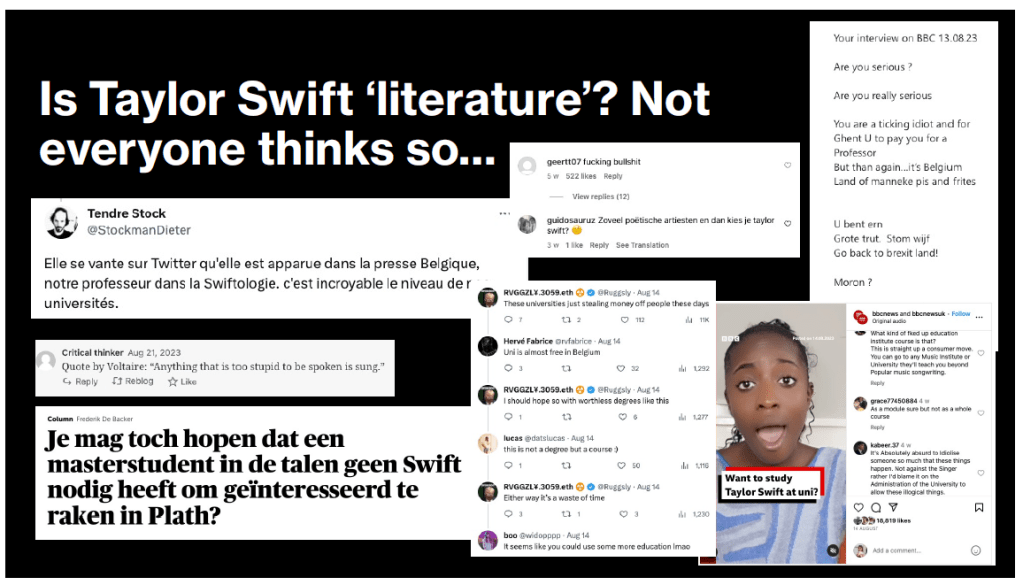
4. Those of you who read my post on gatekeeping and the classroom as kindergarten will know that English Literature (Taylor’s Version) has attracted a fair amount of critique from keyboard warriors, disgruntled men, journalists, and certain members of the academic community. Examining this critique further raises a host of assumptions that demand unpacking, many of which relate to point 2 in this list. Why does a university course focusing on popular culture automatically spark critique coalesced around the notion of ‘dumbing down’? Why does popularity always generate anxiety, with the immediate assumption that what is popular cannot possibly be of cultural value (especially if it’s predominantly consumed and enjoyed by young women)? What even is ‘cultural value’, and why do we assume this to be an objective concept? Why does a substantial proportion of the critique latch, misogynistically, onto Swift’s work as being only about ‘boys and breakups’, and what does that tell us about feminism and the literary canon? If Taylor Swift is apparently not worthy of literary study, what is? And who decided? We need to critically examine these questions and assumptions to understand the complex ways in which culture, and our responses to culture, are undergirded by – among others – capitalism, elitism, racism and sexism.

 Swifterature
New Swiftie here!! (After years of not liking her for no reason other than internal misogyny and the media- I would have never thought Id become such a fan that I would find your blog bc Im so interested in learning more about her literary skills from a professional standpoint.)
It took me til this summer to really dive into Swifts catalog. My journey began shortly after all the hype between her and Travis. I would be reading the comment section and find numerous of her fans defending her against the “Dads, Brads and Chads” of the football world, using some of her more poet songs to prove how she is just not all about “boys and breakups”. This perked my interest because I think of Taylor Swift as her radio hits “We are never getting back together”, “Shake it Off”, etc.
One that stood out was “Ivy” – it read like something out of an old book of poems forgotten but still powerful. So, I dived into her discography, Holy sh*t was Folklore and Evermore 2 amazing journeys to travel down. The I listened to “The Lakes”- “I want auroras and sad prose, I want to watch wisteria grow right over my bare feet, ‘Cause I haven’t moved in years”… and to add that hauntingly beautiful instrumentals, the violins, all of it, was just perfection. Her ways to evoke emotions and images in a way that not many can. Her talent to be able to be a chameleon in the industry, from “Ivy” to “Evermore”, To “The Lakes” and “Right Where You Left Me”, or “Look What You Made Me Do” and “Paper Rings” or “Maroon” and “False God” or “Midnight Rain”. She has music for every mood. THAT IS TALENT!!!
I appreciate the work that you have done to make this more mainstream and to show the comparison between Swift and many great poets. I am thrilled to be able to follow along with your classes online and look forward to your new posts. Thank you for your hard work!
Signed – Angela from Wisconsin, USA