

Now that the glitter has settled on The Life of a Showgirl’s release, and I’ve spent enough time on Reddit fan forums and the comments section of Instagram to feel that I’ve gained both a comprehensive overview of audience reactions and a deep, visceral need to go outside and touch some grass, I wanted to… Continue reading Is it ‘Actually Romantic’ to renounce one’s feminism?
Tag: Swifterature

Bake It Off: the ultimate Taylor Swift baking book
My Taylor Swift inspired cookbook, BAKE IT OFF, comes out on 2 October! (Yes, in perfect time for your listening parties for The Life of A Showgirl!) I am so excited to share this with you all after working so hard on it for months and testing every recipe to perfection. It's packed with glitter,… Continue reading Bake It Off: the ultimate Taylor Swift baking book

The peak before the prison house: Swift, Wordsworth, and the Romantic child
Taylor Swift opens ‘the lakes’, a bonus track from her 2020 album folklore, with the line ‘is it romantic’, and then goes on to pun about William Wordsworth and allude to the British Romantic poets, who were known for being inspired by the Lake District. However, it’s not actually Swift’s most Romantic song — not… Continue reading The peak before the prison house: Swift, Wordsworth, and the Romantic child

Swifterature: the book. Coming 4 November
You can find countless articles online – and a few books by now, too – listing all the literary allusions in Taylor Swift’s work, many of which I've also documented on this blog. Beyond suggesting that Swift is familiar with some English literary classics, though, these lists don’t really tell us much at all. When… Continue reading Swifterature: the book. Coming 4 November

Taylor Swift: The New Romantic Poet
In this essay by high school student Anthony Daans (who kindly allowed me to give some feedback on his project), he argues for Taylor Swift as a modern Romantic poet, while also exploring some of the ways in which this persona might stand at odds with other aspects of Swift's career. Thank you so much,… Continue reading Taylor Swift: The New Romantic Poet

Coming Soon: My First Taylor Swift Book!
Straight from the tortured poets department, I am absolutely ecstatic to announce something out of my Wildest Dreams: my first TAYLOR SWIFT BOOK will be published in January! It's a collection of 46 songs - from Debut to TTPD - with annotated lyrics and accompanying literary analysis, taking a super deep dive into the poetic… Continue reading Coming Soon: My First Taylor Swift Book!
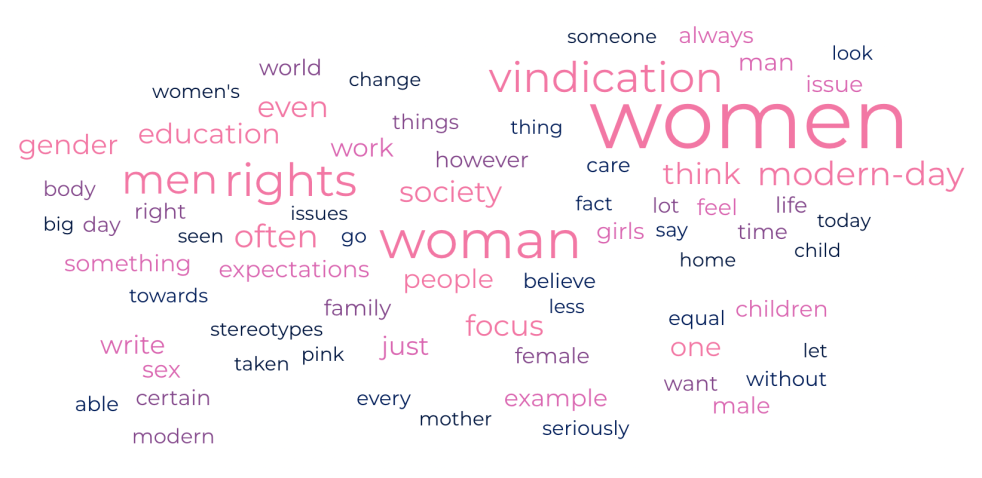
Why do we need feminism? Thoughts from English Literature (Taylor’s Version)
As part of our session on feminism, writing and power, we looked at Mary Wollstonecraft's seminal 'Vindication of the Rights of Woman', a 1792 treatise that argued for the importance of women's education during a period where it was habitually denied. Expected to be little more than delicate parlour ornaments, women were not seen as worthy recipients of the kind of education offered to men - a state of affairs which Wollstonecraft laments, while pointing out its idiocy (surely men would prefer a wife with whom they can hold a conversation). As a thought experiment, I asked my students: 'If you could write a modern-day "Vindication of the Rights of Woman", what feminist - or gender-related - issue would you focus on, and why?' Here are some of the responses - you can also see a word cloud of the most frequently used terms above. Click on it to read more.
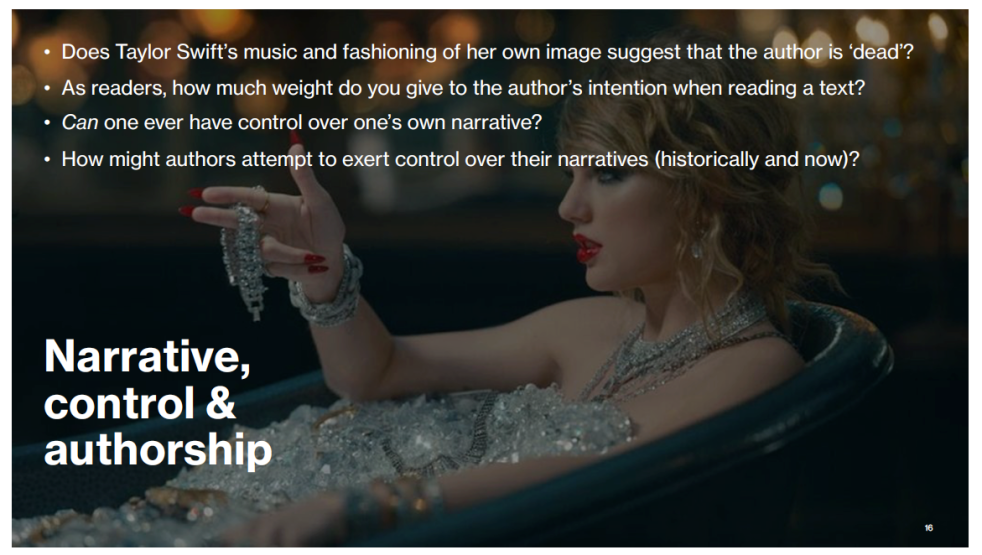
English Literature (Taylor’s Version): Seminar 3
[By Birgit de Schrijver] In the third seminar we looked at the role of the author. More specifically the influence of the author when it comes to our interpretation of certain texts (or songs). When looking at “Jabberwocky” by Lewis Carroll, we came across many nonsense words which made it difficult to understand the poem. However, this gave us a lot of freedom in interpreting it since there didn’t seem to be a right or wrong meaning. Where Jabberwocky gave us a lot of freedom, part of this was taken away by Carroll's “Through the Looking Glass”. Here, Humpty Dumpty gives us (sometimes confusing) explanations for the nonsense words. Unfortunately, by telling us what something means, we are deprived of our own interpretation. We discussed that often the explicit interpretation of the author limits the interpretation of the reader. [Click above image to read more]
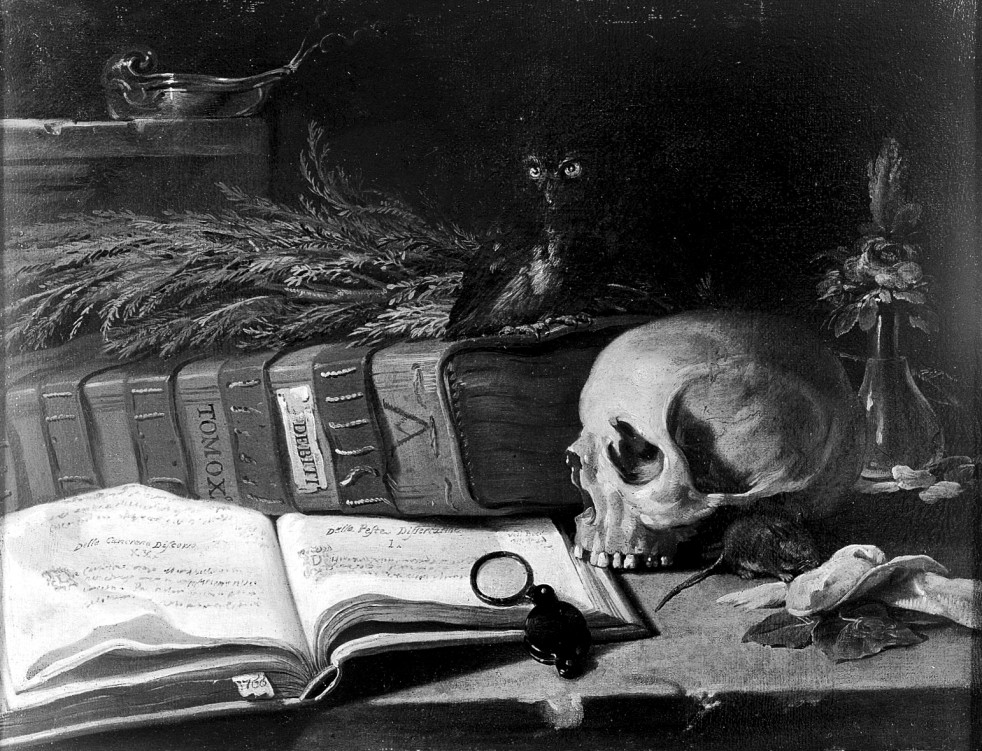
Baited hooks and silly books: why Taylor Swift is the new Gothic novel
‘Too many young women yearn for annihilation’, reads the clickbaity subtitle of Mary Harrington’s article ‘The Dark Truth about Taylor Swift’. Published on 16 August 2023, Harrington’s piece observes a troubling tendency in young women towards ‘a craving for romantic transcendence that’s difficult to distinguish from self-destruction’: in other words, an obsession with, and yearning for, love affairs made all the more intense by the knowledge that they are doomed to failure (such as Jack and Rose from Titanic, or Romeo and Juliet). Harrington attributes some of Swift’s popularity to the fact that her oeuvre satisfies this desire: her best songs are about romantic liaisons that don’t end well (‘got a history of stories ending sadly’). Harrington then goes on to link this to thirteenth-century France and the massacre of the Cathar sect of Christianity, who saw our incarnated world as fundamentally evil and longed to escape the ‘prison’ of flesh to return to unity with God. Following their persecution during the Albigensian Crusade, the Cathars’ beliefs went underground and spawned what we now know as ‘courtly love’ literature.
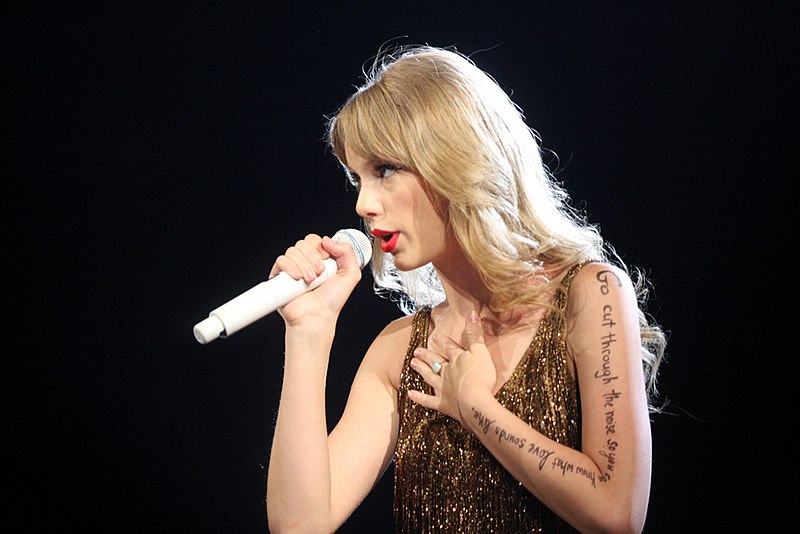
What is Swifterature?
Lately, my inbox is strewn (between the cute animal videos and instagrammable recipe content) with links sent by friends and colleagues to articles with titles such as ‘20 Taylor Swift songs with literary references you may have missed’ and ‘Taylor Swift’s songs are full of literary references - so what do they tell us?’ Since the 2020 release of Swift’s interlinked albums Folkore and Evermore, which she herself declared the product of being unable to stop telling stories as her imagination ran wild during lockdown, increasing interest has been paid to Swift as a self-consciously literary artist, whose works brim with references to everything from Alice in Wonderland to The Great Gatsby. Leading Shakespeare professor Jonathan Bate recently advocated for Taylor Swift as a ‘literary giant’ in The Sydney Morning Herald, the subtitle of his article declaring that he would ‘compare her (favourably) to the greats of poetry and prose’. Having long sent her eagle-eyed fans hunting for the famous ‘easter eggs’ with which she mischievously peppers her lyrics and videos, Swift’s work now seems to invite us on a quest to identify and collect her numerous literary allusions. Everyone from the Swiftie community on Reddit to English literature professors have eagerly risen to the challenge.
 Swifterature