

As preparation for one of our seminars in English Literature (Taylor's Version) — in which we look at connections between writing, gender, and power, focusing on Taylor Swift's 'The Man', 'mad woman', 'Dear John', 'Hits Different', and 'the last great american dynasty' — I ask students to write a modern-day version of 'A Vindication of… Continue reading On being, and not being, The Man: modern-day vindications of gender rights
Tag: gender

What about Wendy? Adaptation, interrogation, and turning on the light
When Swift’s speaker sings in ‘cardigan’ that the object of the song ‘tried to change the ending, Peter losing Wendy’, she encourages us to go back and take a closer look at a story that may have been a staple of our childhoods. The line is deeply ambiguous, and has always puzzled me. It’s unclear whether he tried to change the (happy) ending, making it so that Peter instead lost Wendy; whether he tried and failed to change the (unhappy) ending of Peter losing Wendy; whether he tried to change the (unhappy) ending, but Peter lost Wendy anyway. Is Peter losing Wendy the result of his actions, or the fate he tried to change? [Click above image to read on.]
Why do we need feminism? Thoughts from English Literature (Taylor’s Version)
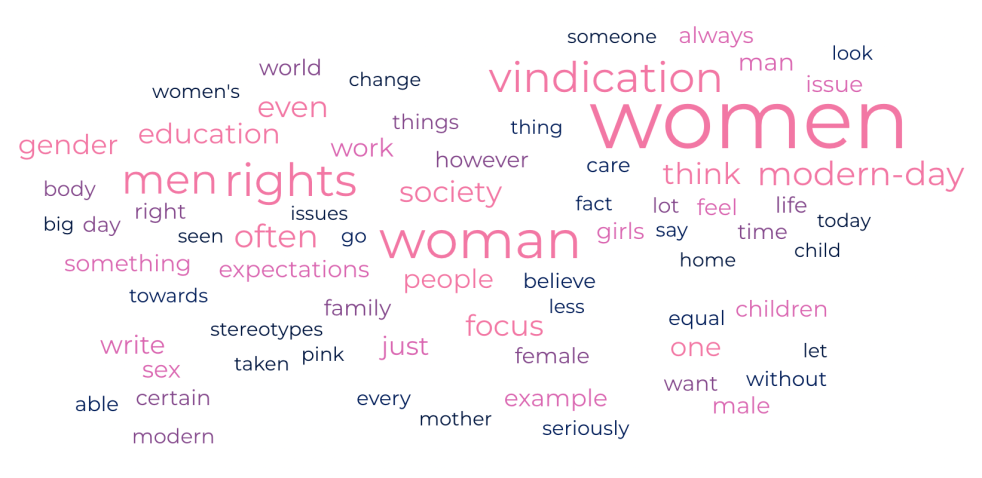
As part of our session on feminism, writing and power, we looked at Mary Wollstonecraft's seminal 'Vindication of the Rights of Woman', a 1792 treatise that argued for the importance of women's education during a period where it was habitually denied. Expected to be little more than delicate parlour ornaments, women were not seen as worthy recipients of the kind of education offered to men - a state of affairs which Wollstonecraft laments, while pointing out its idiocy (surely men would prefer a wife with whom they can hold a conversation). As a thought experiment, I asked my students: 'If you could write a modern-day "Vindication of the Rights of Woman", what feminist - or gender-related - issue would you focus on, and why?' Here are some of the responses - you can also see a word cloud of the most frequently used terms above. Click on it to read more.

English Literature (Taylor’s Version): Seminar 4
In Seminar 4 of English Literature (Taylor's Version), we looked at the relationship between writing, gender and power, asking what Taylor Swift can teach us about literary feminism. We listened to 'Right Where You Left Me', 'Dear John', 'Mad Woman', 'Hits Different' and 'The Man', asking: What construction(s) of femininity do we see in the song? What is the relationship between writing and power? Are there any literary allusions? Is this a 'feminist' song? if so, why? If not, why not? We used this discussion - also bringing in Swift's re-recording of her masters, seen by many as a feminist act - to segue into two important feminist literary texts: Mary Wollstonecraft's 'Vindication of the Rights of Woman' (1792) and Charlotte Perkins Gilman's The Yellow Wallpaper (1892). [Click above image to read more]

English Literature (Taylor’s Version): Seminar 2
In English Literature (Taylor's Version) seminar 2 - titled 'This Ain't a Fairytale: Chivalry and the Knight in Shining Armour' - we looked at the anonymous 14th century poem Sir Gawain and the Green Knight, written in Middle English (though we used the excellent Simon Armitage poetic translation). Students had also watched the 2021 film The Green Knight - a very free adaptation of the poem by filmmaker David Lowery and starring Dev Patel - in advance of the seminar, and were asked to write either a short opinion piece on the film, or their thoughts on the idea of chivalry. [Click the above image to read more]
 Swifterature