

In Seminar 4 of English Literature (Taylor's Version), we looked at the relationship between writing, gender and power, asking what Taylor Swift can teach us about literary feminism. We listened to 'Right Where You Left Me', 'Dear John', 'Mad Woman', 'Hits Different' and 'The Man', asking: What construction(s) of femininity do we see in the song? What is the relationship between writing and power? Are there any literary allusions? Is this a 'feminist' song? if so, why? If not, why not? We used this discussion - also bringing in Swift's re-recording of her masters, seen by many as a feminist act - to segue into two important feminist literary texts: Mary Wollstonecraft's 'Vindication of the Rights of Woman' (1792) and Charlotte Perkins Gilman's The Yellow Wallpaper (1892). [Click above image to read more]
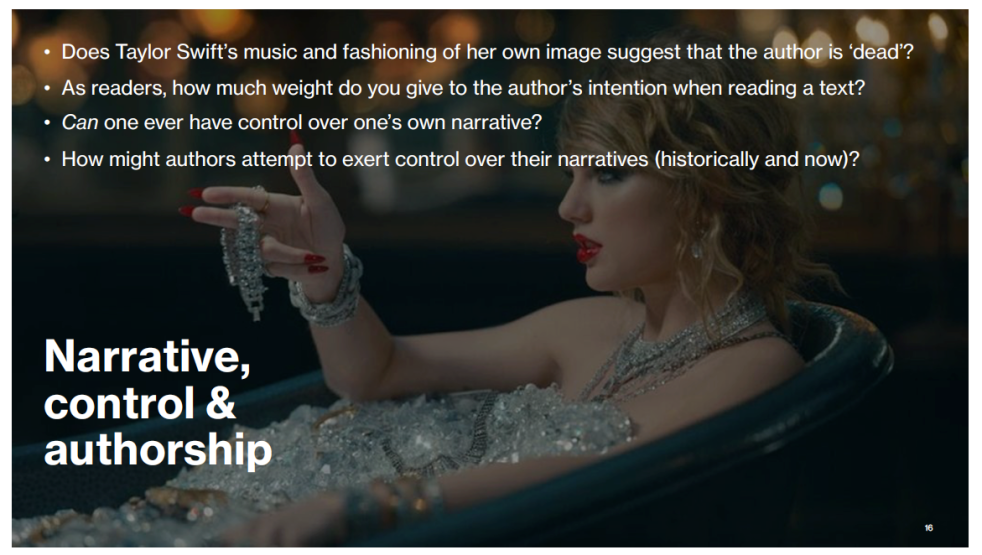
English Literature (Taylor’s Version): Seminar 3
[By Birgit de Schrijver] In the third seminar we looked at the role of the author. More specifically the influence of the author when it comes to our interpretation of certain texts (or songs). When looking at “Jabberwocky” by Lewis Carroll, we came across many nonsense words which made it difficult to understand the poem. However, this gave us a lot of freedom in interpreting it since there didn’t seem to be a right or wrong meaning. Where Jabberwocky gave us a lot of freedom, part of this was taken away by Carroll's “Through the Looking Glass”. Here, Humpty Dumpty gives us (sometimes confusing) explanations for the nonsense words. Unfortunately, by telling us what something means, we are deprived of our own interpretation. We discussed that often the explicit interpretation of the author limits the interpretation of the reader. [Click above image to read more]

English Literature (Taylor’s Version): Seminar 2
In English Literature (Taylor's Version) seminar 2 - titled 'This Ain't a Fairytale: Chivalry and the Knight in Shining Armour' - we looked at the anonymous 14th century poem Sir Gawain and the Green Knight, written in Middle English (though we used the excellent Simon Armitage poetic translation). Students had also watched the 2021 film The Green Knight - a very free adaptation of the poem by filmmaker David Lowery and starring Dev Patel - in advance of the seminar, and were asked to write either a short opinion piece on the film, or their thoughts on the idea of chivalry. [Click the above image to read more]
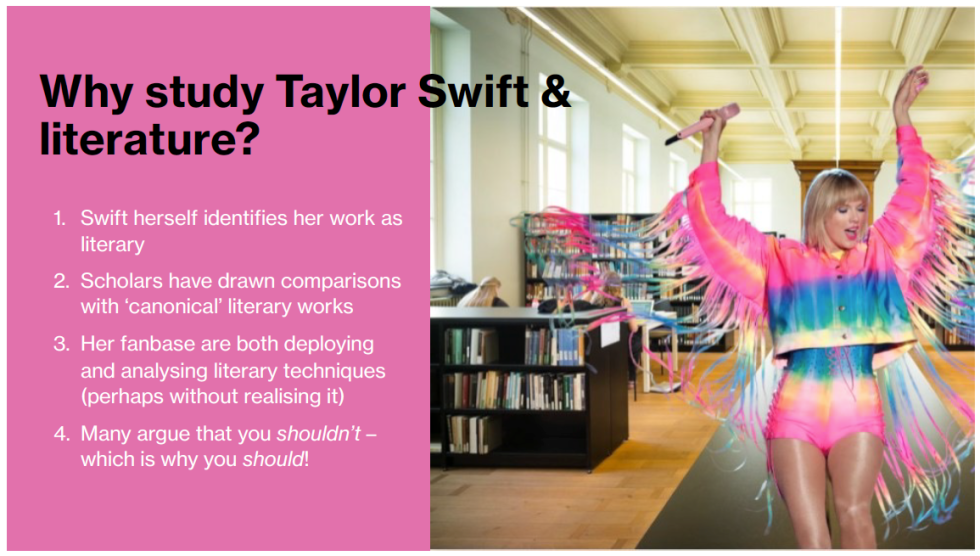
English Literature (Taylor’s Version): Seminar 1
In the first seminar of English Literature (Taylor's Version) at Ghent University, we looked at four reasons to study Taylor Swift's work alongside English literature. [Click the image above to read more.]
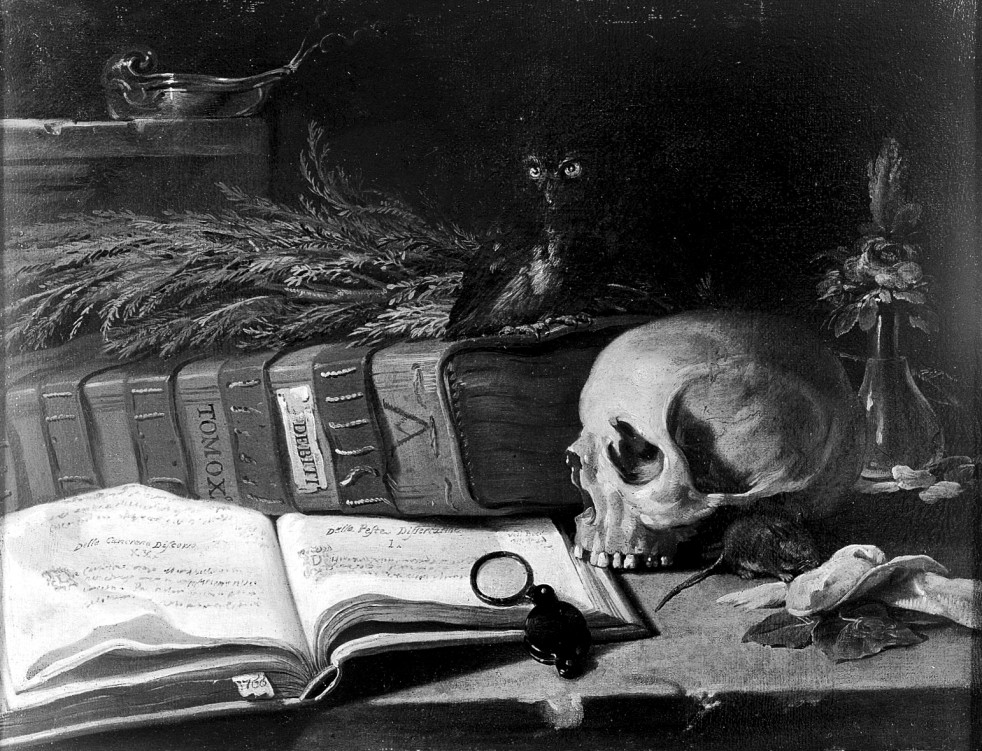
Baited hooks and silly books: why Taylor Swift is the new Gothic novel
‘Too many young women yearn for annihilation’, reads the clickbaity subtitle of Mary Harrington’s article ‘The Dark Truth about Taylor Swift’. Published on 16 August 2023, Harrington’s piece observes a troubling tendency in young women towards ‘a craving for romantic transcendence that’s difficult to distinguish from self-destruction’: in other words, an obsession with, and yearning for, love affairs made all the more intense by the knowledge that they are doomed to failure (such as Jack and Rose from Titanic, or Romeo and Juliet). Harrington attributes some of Swift’s popularity to the fact that her oeuvre satisfies this desire: her best songs are about romantic liaisons that don’t end well (‘got a history of stories ending sadly’). Harrington then goes on to link this to thirteenth-century France and the massacre of the Cathar sect of Christianity, who saw our incarnated world as fundamentally evil and longed to escape the ‘prison’ of flesh to return to unity with God. Following their persecution during the Albigensian Crusade, the Cathars’ beliefs went underground and spawned what we now know as ‘courtly love’ literature.
I Don’t Like Your Kingdom Keys: Literature, Gatekeeping, and the Classroom as Kindergarten
Well, this escalated. One minute I’m typing idle thoughts into a sticky note on my laptop about all the ways in which we might connect Taylor Swift songs with literature (and positing frivolous titles for such a course, like ‘Now I’ve Read All of the Books Beside Your Bed’); the next, I’m setting alarms for 3.30, 4.30, 5.30 and 7am so I can talk about this initiative to Dubai, Germany, Austria, Belgium, the US and Ireland, or rushing around trying to find a quiet corner in the middle of an American university campus where I can chat live to BBC News. Following segments on the Ukraine war and the Iran hijab protests with my chirpy musings on Swift (not Jonathan) and literature is one of the more surreal things I’ve done in my career.

Help, I’m still at Satis House: reclaiming female stasis
Everybody moved on/I, I stayed there/Dust collected on my pinned-up hair In Chapter 8 of Charles Dickens’s classic novel Great Expectations (1861), the anxious young Pip is led by his playmate Estella to meet the mysterious Miss Havisham at her home, Satis House. Upon entering, Pip finds himself ‘in a pretty large room, well lighted… Continue reading Help, I’m still at Satis House: reclaiming female stasis

Uncomfortable (in)appropriations: ‘Daddy’ and ‘The Great War’
The first bonus track of Taylor Swift’s 2022 album Midnights - featuring on the ‘3am edition’ - is titled ‘The Great War’. I remember listening to it in my kitchen as I stacked the dishwasher, an act of quotidian mundanity incongruously soundtracked by Swift’s passionate hymning of a relationship that, against the odds, survives a ‘great war’ of miscommunication, paranoia, distrust and past trauma only to come out stronger: ‘I vowed I would always be yours/’Cause we survived the Great War’. It features a veritable litany of figurative language in which love becomes a battle, heartbreak becomes death, emotional wounds literal bruises. So far, so Swift. But when the song reached the bridge, where Swift sings the lines, ‘We could plant a memory garden/Say a solemn prayer, place a poppy in my hair’, I felt an uneasiness kicking in. What was strange is that I recognised it as a very specific kind of uneasiness, because I had felt it precisely once before.
What is Swifterature?
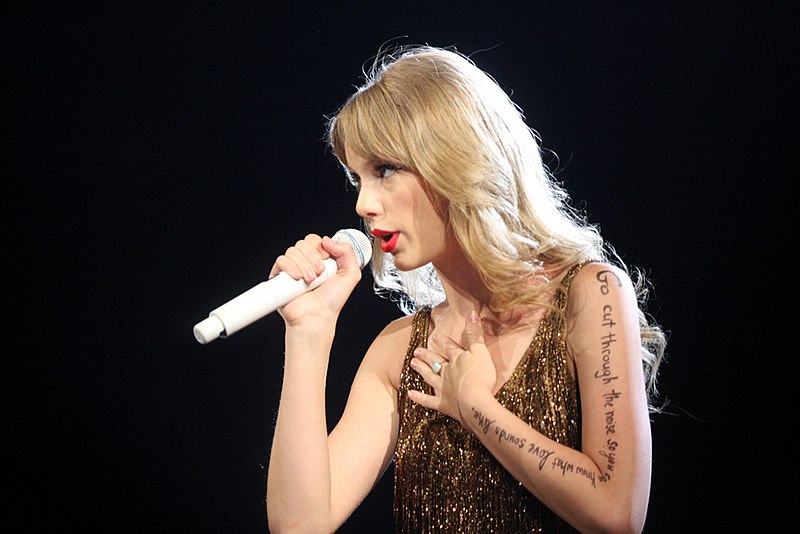
Lately, my inbox is strewn (between the cute animal videos and instagrammable recipe content) with links sent by friends and colleagues to articles with titles such as ‘20 Taylor Swift songs with literary references you may have missed’ and ‘Taylor Swift’s songs are full of literary references - so what do they tell us?’ Since the 2020 release of Swift’s interlinked albums Folkore and Evermore, which she herself declared the product of being unable to stop telling stories as her imagination ran wild during lockdown, increasing interest has been paid to Swift as a self-consciously literary artist, whose works brim with references to everything from Alice in Wonderland to The Great Gatsby. Leading Shakespeare professor Jonathan Bate recently advocated for Taylor Swift as a ‘literary giant’ in The Sydney Morning Herald, the subtitle of his article declaring that he would ‘compare her (favourably) to the greats of poetry and prose’. Having long sent her eagle-eyed fans hunting for the famous ‘easter eggs’ with which she mischievously peppers her lyrics and videos, Swift’s work now seems to invite us on a quest to identify and collect her numerous literary allusions. Everyone from the Swiftie community on Reddit to English literature professors have eagerly risen to the challenge.
 Swifterature