

Now that the glitter has settled on The Life of a Showgirl’s release, and I’ve spent enough time on Reddit fan forums and the comments section of Instagram to feel that I’ve gained both a comprehensive overview of audience reactions and a deep, visceral need to go outside and touch some grass, I wanted to share an interesting literary parallel I picked out after a few listens — and no, it has nothing to do with Hamlet.
By now, you’ll be able to find lists online detailing all the perceived misogynistic references in Swift’s The Life of a Showgirl. To be a showgirl, it would seem, you must also be a No-Girl(‘s girl). There’s the ‘diss track’ — rumoured to be about a fellow female musician — that is ‘Actually Romantic’; the perceived celebration of cheating found in both ‘Ruin the Friendship’ and ‘CANCELLED!’; and the mockery of ‘the bitches who wish I’d hurry up and die’ in the title track.
Having delivered an earnest monologue in her 2019 Netflix documentary, Miss Americana, in which she declared that ‘there’s no such thing as a bitch’, and outlined her attempts to banish her internalised misogyny, Swift seems to inhabit an alternate multiverse for The Life of a Showgirl (or perhaps it’s Kitty Finlay speaking, rather than Swift herself). The b-word peppers the album almost as liberally as ‘fuck’ does The Tortured Poets Department. It is also joined by ‘slut’ — another word Swift decried in that 2019 monologue.
Most interestingly, though, is the context in which Swift uses these words on Showgirl. The Spectator claim that, with this album, Swift has ‘shattered feminism’s fragile lie’. They note — rather too gleefully, if you ask me — that ‘suddenly, the woman who once made a religion of independence is daydreaming about devotion, permanence, and family’. The driveway with the basketball hoop. Settling down and having a couple of kids. Being called ‘honey’. Not having ‘savage’ things to say online, but wanting to revisit an age of childhood innocence, ‘ferris wheels, kisses and lilacs’. The entire album reads like a love letter to Swift’s fiancé, Travis Kelce, in which the onyx skies of the past clear and reveal the Blank slate (or Space) that is their opalite future.
Swift, who asked in ‘Blank Space’, ‘nice to meet you, where you been?’ and dedicated an entire song to musing on the past loves of her then-muse Joe Alwyn (‘All Of the Girls You Loved Before’), is now declaring ‘Don’t care where the hell you’ve been, ‘cause now you’re mine’ (‘The Fate of Ophelia’). The persona Swift adopts on Showgirl seems to be reading from a romance manual in which devotion is expressed through renouncing one’s past self and remaking oneself anew in the image of one’s beloved (consider the Kelce-esque slang that sits alongside those ‘bitch’ references throughout the album). What better romantic gesture (aside from white diamonds and Cartier) than an album bidding a symbolic farewell to the past — the narrowly-dodged Fate of Ophelia — and anticipating that new, settled-down future? What more dramatic way to signal farewell to that past than by vocally shattering ‘feminism’s lie’?
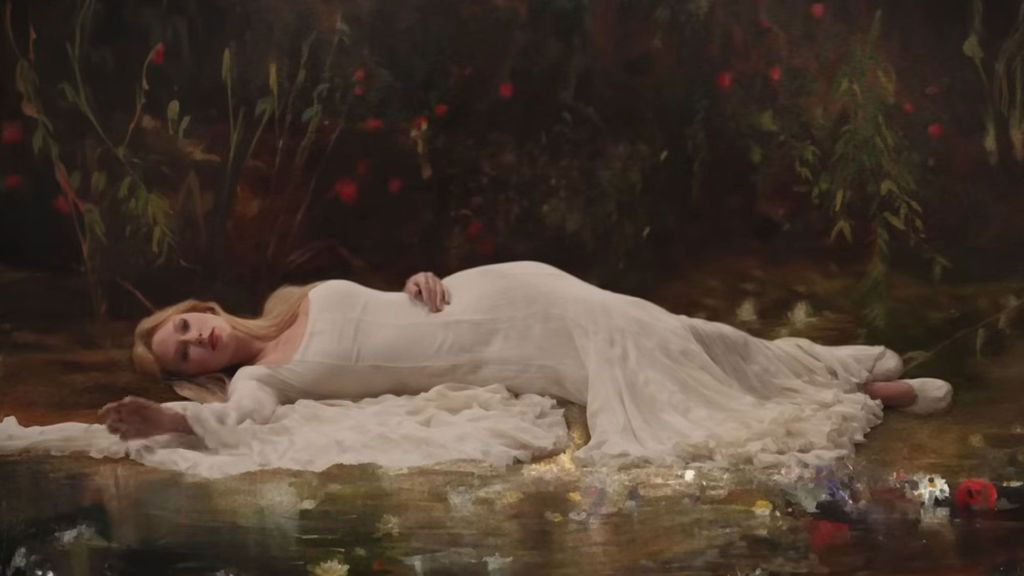
As the Spectator put it, Swift in the past ‘embodied the millennial ideal of success: autonomous, ambitious, and emotionally unanchored. She sang of triumphs, trophies, and the thrill of dancing alone.’ This was coupled with an aversion to those misogynist slurs she decried in Miss Americana, and a critique of the ‘1950s shit’ people wanted from her (namely, marriage). What better way to clearly signal her split from this mentality, then, and to announce her ‘engaged era’, than to declare explicitly, ‘when I said I didn’t believe in marriage, that was a lie’, and to start throwing around casual ‘bitch’ references? Is this what is ‘actually romantic’ about The Life of a Showgirl — the intimation that that past feminism was just a front? Just the wolf’s clothes in which this dying-from-trying-to-seem-cool sheep had dressed, in order to look ‘fire’?
This, naturally, has polarised Swift’s fan base, as the Spectator noted: ‘many conservatives have welcomed this as a long-awaited turn toward sanity […] Meanwhile, left-wing Swifties are in chaos. Some progressives have accused Swift of going “full MAGA”’. I have my own thoughts on whether I like this new direction of Swift’s or not, but that’s not what I want to discuss here. Rather, I wanted to point out that renouncing one’s feminism in the name of romance has interesting artistic precedent.
In 1792, English author and educator Anna Laeititia Barbauld wrote the poem ‘The Rights of Women’. It is often seen as a response to Mary Wollstonecraft’s ‘A Vindication of the Rights of Woman’, published the same year — and a text we discuss in English Literature (Taylor’s Version). In ‘Vindication’, Wollstonecraft argued eloquently for the importance of education for women, critiquing the notion that women should just be beautiful, brainless parlour ornaments for the patriarchy, and highlighting the innumerable benefits to mankind if women were able to enjoy the same academic opportunities as their brothers.
Barbauld’s ‘The Rights of Women’ begins in a similar fashion (as we might expect, given that its title seems a clear allusion to Wollstonecraft’s ‘Vindication’). Its first stanza reads:
Yes, injured Woman! Rise, assert thy right!
Woman! too long degraded, scorned, opprest;
O born to rule in partial Law’s despite,
Resume thy native empire o’er the breast!
It’s a rousing opening, the multiple exclamations and imperatives creating a sense of dramatic urgency, and the tricolon of ‘degraded, scorned, opprest [oppressed]’ emphasising the pitiful state of female autonomy in the eighteenth century. We might read the last line of the stanza as mocking the traditional roles to which women were encouraged to confine themselves — childrearing (‘the breast’ = breastfeeding) and matters of the heart (held, of course, within the breast) — by suggesting women replace those concerns with armoured breastplates (perhaps both literally and metaphorically – armour up, and free yourself of debilitating emotions that might make you weak).
In the next stanza, the speaker urges women to ‘Go, bid proud Man his boasted rule resign’ and, a few lines later, to ‘Make treacherous Man thy subject, not thy friend’. It reads as a feminist call to arms, urging women to claim the empire that is rightly theirs but has been falsely claimed by men since time immemorial. What weapons should women use to claim it back? ‘Soft melting tones’ [of voice] will be their ‘thundering cannon’s roar’, and their armoury, ‘blushes and fears’. In other words, let’s weaponize traditionally feminine wiles to smash the patriarchy.
Once she has subdued her foes, the speaker suggests, this fearsome female ruler will ‘Awe the licentious, and restrain the rude’. The favours of this ‘courted idol’ will be seen as more desirable than ‘princes’ gifts’. She must reign with an iron fist, merciless and proud, lest she appear weak in front of her subjects.
While not exactly what Wollstonecraft was advocating — she kinda just wanted women to be allowed to go to school; she wasn’t really suggesting a matriarchal coup — Barbauld’s message thus far certainly fits under the umbrella of arguing for women’s rights. However, the final two stanzas then pull a ‘love of your life/loss of my life’ kind of twist that I think Taylor would enjoy:
But hope not, courted idol of mankind,
On this proud eminence secure to stay;
Subduing and subdued, thou soon shall find
Thy coldness soften, and thy pride give way.Then, then, abandon each ambitious thought,
Conquest or rule thy heart shall feebly move,
In Nature’s school, by her soft maxims taught,
That separate rights are lost in mutual love.
In a nutshell, Barbauld is suggesting here that, once this Amazonian advocate falls in love, her righteous exterior will soon melt. She will abandon her ambition, no longer be moved by the desire for ‘conquest or rule’, and instead come to the realisation that ‘separate rights are lost in mutual love’. In other words, once you meet the right partner, you will give up all these wild notions of gendered rights and, it is implied, focus instead on moving forward as a family unit rather than pursuing one’s own selfish goals. On — to quote the Spectator again — ‘rediscovering what women across centuries have known instinctively: that love, marriage, and motherhood are not cages, but fulfilling callings.’
Goodbye feminist era, hello domestic bliss era.
Is it that big a leap to The Life of a Showgirl, and specifically to ‘Wi$h Li$t’, where Swift seems to gently mock those who prioritise their looks (‘fat ass with a baby face’), hedonistic social life (‘spring break that was fucking lit’), material goods (‘yacht life’ and ‘balenci shades’) or, even, their dogs (‘that they call their kids’) over settling down and populating the whole block with their (human, not canine) offspring? Where she admits that she thought she ‘had it right, once, twice, but I did not’, and suggests an epiphany about what really matters in life, prompted by her ‘best friend who I think is hot’? Or to ‘Wood’, in which the speaker celebrates the abandoning of her former superstitions and her ‘bitching’, intimating that her lover has unveiled her ‘real’ self like a key turned in a lock? Might this not read as a symbolic relinquishment of those more progressive values, in favour of feeling loved and protected by her new partner? And what about ‘The Fate of Ophelia’, where Swift — who formerly specified to her lover that ‘you don’t need to save me’ (‘Call It What You Want’) — apparently celebrates being saved, by another lover?
Now, it’s important to note here that Barbauld’s poem is complex, nuanced, and has prompted much scholarly discussion as to what her ‘real’ message might have been. It can certainly be read as mostly satirical — as nicely argued by this Guardian article — calling into doubt how seriously we are supposed to take the speaker’s apparent promotion of romantic love over feminist goals. Much of the poem is hyperbolic, but is Barbauld mocking Wollstonecraft, or Wollstonecraft’s detractors and opposers? Is the notion that ‘separate rights are lost in mutual love’ Barbauld’s own belief, or her savaging the patriarchy’s notion that women can be correctly tamed by the right man, ‘ahh’-matized into retracting all that wild feminist nonsense floating around in their mostly empty heads? What, or who, is actually being mocked and critiqued, here?
Perhaps we can never really know, and perhaps this is how we should approach Swift’s Showgirl, too. She has described the album at certain points as ‘satirical’, and there’s clearly an element of Sabrina Carpenter-style playfulness in songs like ‘Wood’. Has Swift Actually Romantically reverted to conservatism, or is she mocking the way in which everyone expects her to ‘boss up settle down’ now that she’s a Showgirl with that ‘hard rock’ on her finger? In a recent radio interview with the BBC, Swift described the idea that she is going to stop making music once she marries as ‘shockingly offensive’, but it is almost certainly a public opinion of which she has been conscious of for a long time (hence the dismissal of ‘that 1950s shit they want from me’ on ‘Lavender Haze’).
Perhaps the persona of Showgirl is the latest evolution of the satirical persona Swift adopted in ‘Blank Space’ to mock public misogyny regarding her romantic life: this new iteration of the persona mocks the fact that we speculate at all over how much a female musician’s life and output might change after marriage and motherhood, in a way we would never think to do with her male counterparts. Perhaps the jarring (in comparison with her earlier work) nature of Swift’s ‘bitch’ and ‘slut’ references, and paeans to settled domesticity, are exactly the point. They are subdued battle cries, designed to alert us to our own hypocrisy and double standards; to remind us just how far we still have to go in the creation of a world in which ‘separate rights’ and ‘mutual love’ don’t have to be mutually exclusive. Perhaps that’s really what should be top of our Wi$h Li$ts.

 Swifterature