

Taylor Swift opens ‘the lakes’, a bonus track from her 2020 album folklore, with the line ‘is it romantic’, and then goes on to pun about William Wordsworth and allude to the British Romantic poets, who were known for being inspired by the Lake District. However, it’s not actually Swift’s most Romantic song — not by a long stretch.
That song is, instead, ‘seven’ — also from folklore. Its opening lines implore the listener to ‘please picture me in the trees/I hit my peak at seven’. It’s awash with nostalgic childhood memories — sweet tea in the summer, braided hair, dolls and wild dreams of escaping to India — and recalls the days when the speaker could ‘scream ferociously’ in the weeds, anytime she wanted, before she ‘learned civility’.
I want to argue that ‘seven’ is a modern-day take on William Wordsworth’s 1807 ‘Ode: Intimations of Immortality from Recollections of Early Childhood’, and that the way Taylor Swift writes about childhood throughout her oeuvre is indebted to the Romantic poets — and Wordsworth in particular.
Romanticism — it’s always impossible to date literary movements exactly, but its heyday spanned roughly the late eighteenth to mid-nineteenth centuries — emphasised intellect, imagination, intuition, inspiration, and emotion. There are a lot of ‘I’ words there, which is fitting, since Romanticism focused heavily on individual subjectivity. We use a capital ‘R’ to distinguish it from the romantic (related to sexual love) and from romance (medieval narratives of heroism and adventure), although Romanticism often incorporated both of these things. It also changed, forever, the way we think about children and childhood.
In the opening lines of ‘Intimations of Immortality’, Wordsworth describes how there was a time when:
meadow, grove, and stream
The earth, and every common sight
To me did seem
Appareled in celestial light.
This time is childhood, in which we are as close to heaven as we will ever be: we are born ‘trailing clouds of glory’ from ‘God, who is our home’. But, although heaven ‘lies about us in our infancy,’ Wordsworth intimates, ‘shades of the prison-house begin to close’ upon us as we start to grow up. We are increasingly burdened with life’s difficulties, and our whole life is one long ‘forgetting’: we grow further and further away from the ‘celestial light’ of childhood, trapped by the dark walls of the mundane everyday. Speaking of and to the child in the poem, Wordsworth warns that ‘full soon thy Soul shall have her earthly freight’. Swift says something almost identical, over two centuries later, in ‘Robin’: children live ‘in sweetness’, but ‘the time will arrive for the cruel and the mean’. Similarly, in ‘Never Grow Up’: ‘To you, everything’s funny/You got nothing to regret’ — yet, is the unspoken, poignant implication.
The speaker of Wordsworth’s ‘Ode’ laments that ‘the things which I have seen I now can see no more’. He has lost his child’s sense of wonder, and no longer sees the world with that glow of ‘celestial light’. It’s a similar sentiment to that voiced by Swift in ‘Innocent’:
Wasn’t it easier in your lunchbox days?
Always a bigger bed to crawl into
Wasn’t it beautiful when you believed in everything
And everybody believed in you?
Those days are, of course, no more — the song’s object (Kanye West) was 32 when Swift wrote it. Read in the context of Swift’s other works about childhood, then, the admission that the speaker ‘learned civility’ in ‘seven’ has highly negative connotations. The implication is that the unbridled, liberated child — who could scream and express herself any time she wanted — was forced to suppress her wildness and tame her feelings to become more socially acceptable for her adult environment; no longer the weeds, but probably the city, or the home. She recalls being in the trees, ‘high in the sky/with Pennsylvania under me’; there’s the implication that the child is able to see the world more expansively and widely than the adult, who becomes bogged down in the mundane details of adult life; they literally can’t see the wood for the trees, unlike the speaker of ‘seven’.
Wordsworth, too, looks sadly upon the child trying to play at being ‘grown-up’ with ‘some little plan or chart’, noting that the time for this will come all too soon:
Thou little Child, yet glorious in the might
Of heaven-born freedom on thy being’s height,
Why with such earnest pains dost thou provoke
The years to bring the inevitable yoke,
Thus blindly with thy blessedness at strife?
Again, this parallels Swift in ‘Never Grow Up’:
You’re in the car on the way to the movies
And you’re mortified your mom’s droppin’ you off
At fourteen, there’s just so much you can’t do
And you can’t wait to move out someday and call your own shots
But don’t make her drop you off around the block
Remember that she’s gettin’ older too
And don’t lose the way that you dance
Around in your PJs getting ready for school
[…]
Take pictures in your mind of your childhood room
Memorize what it sounded like when your dad gets home
Remember the footsteps, remember the words said
And all your little brother’s favorite songs
I just realized everything I have is someday gonna be gone.
With the benefit of hindsight, and overwhelmed by nostalgia for her own carefree childhood, Swift urges the child of ‘Never Grow Up’ not to try to cast off their childhood prematurely, but instead to celebrate this ‘peak’ of life, this fugitive age of Wordsworthian glory, before — to paraphrase ‘Innocent’ — the monsters catch up to you. We’re given a vision of this in Swift’s ‘The Best Day’, where the simple pleasures of childhood — pumpkin patches, big coats in winter, painting in the kitchen — constitute the best day of the speaker’s life.
It’s not all doom and gloom, though, for Wordsworth or Swift. There is still some hope. Contact with nature, for Wordsworth, is one of the ways in which adults might try to regain some of that childish joy and innocence, and return to ‘the age of princesses and pirate ships and the seven dwarfs’ (as Swift sings in ‘The Best Day’):
—But there’s a Tree, of many, one,
A single field which I have looked upon,
Both of them speak of something that is gone;
The Pansy at my feet
Doth the same tale repeat:
Whither is fled the visionary gleam?
Where is it now, the glory and the dream?
Those two rhetorical questions are the nineteenth-century equivalent of Swift’s ‘are there still beautiful things?’ in ‘seven’. The speaker feels as if everything since her ‘peak’ at seven has been a slow, creeping downgrading; she is no longer the child who could simply write off her friend’s dad’s anger as being due to a haunted house (‘seven’ has dark undertones of childhood neglect or even abuse). The child in ‘The Best Day’ doesn’t know why the trees change in the fall, and that’s implied to be one of the reasons she’s so happy: she hasn’t yet gained the cruel knowledge of adulthood; the realisation that it’s not a haunted house that makes dads angry all the time.
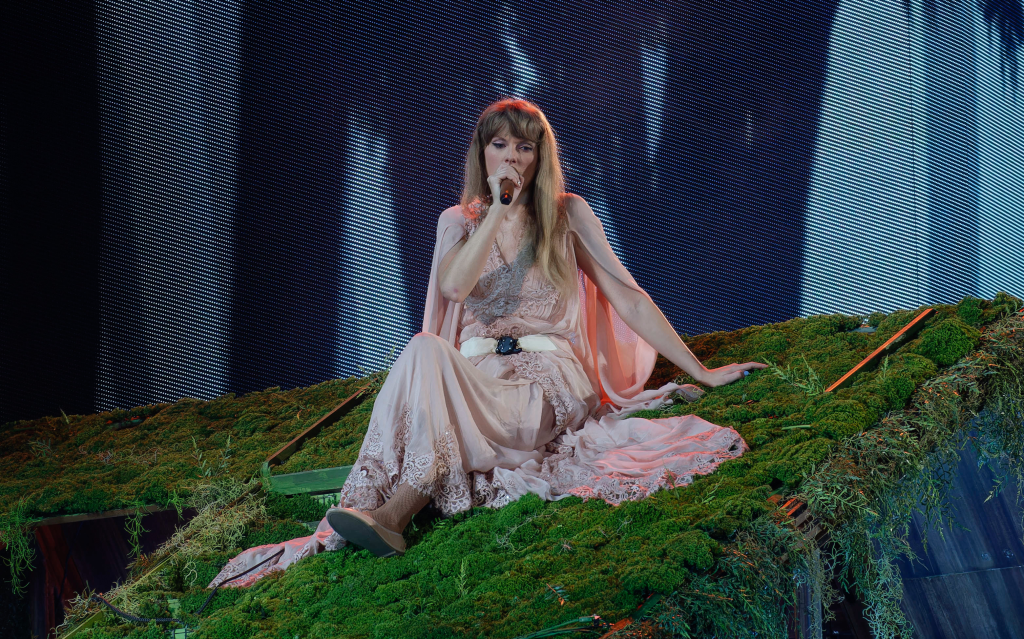
In Wordsworth’s lines, the sight of the tree and the pansy remind the speaker of everything that he has lost since his childhood, but also bring back reminders of that same idyllic childhood. The child is ‘Nature’s Priest’, but the ‘splendid’ vision of nature dies away as he matures, ‘and fade[s] into the light of common day’; it is logical that only through contact with nature, then, can he regain some of that vision. In Swift’s ‘seven’, she asks to be pictured ‘in the trees’ and ‘in the weeds’, celebrating the wildness and contact with nature she enjoyed as a child. The positioning of ‘seven’ on folklore, and the album’s entire cottagecore aesthetic — multiple sepia photos of Swift draped across forest foliage or shrouded in shrubbery — suggest that we, as adults, can never entirely return to our ‘lunchbox days’, but we might be able to get a little closer if we seek out, in Wordsworth’s words, ‘fountains, meadows, hills, and groves’. Swift wrote about the paradoxical freedom she enjoyed during the 2020 Covid lockdown, how it sent her mind running wild with stories. The isolation and enforced contact with a slower pace of life and with nature apparently unlocked her creativity (producing not one but two ‘surprise’ albums that year, both heavily influenced by cottagecore), just as it did for Wordsworth and his contemporaries, whose poems frequently meditated upon nature and landscape.
In Judith Plotz’s book, Romanticism and the Vocation of Childhood, she argues that much of the way in which we tend to conceptualise childhood now, at least in Britain and America, stems from the Romantic poets. Plotz argues that the Romantic poets ‘discovered’ childhood: prior to this period, children were often viewed as miniature adults, rarely given special treatment and often sent to work at a very early age. Poets such as Wordsworth, however, created the idea of childhood as an altered physical and mental state, one that was in closer contact with both the divine and with nature (often interlinked), and which demanded and deserved adult protection: ‘showmanship’, as Swift says in ‘Robin’, to keep everything ‘in sweetness’ and hide the secret of life’s cruelty for as long as possible. Romantic writers ‘invented’ the child as we know it today: associated with innocence, blissful naivety, simpler and more beautiful times, wildness, and closer contact with nature. We see the legacy of the latter in the trend for modern parenting manuals that urge us to get our kids back to nature and away from the damaging influence of screens; at their heart is the fundamental idea that the outdoors is a more ‘natural’ environment or pursuit for the child. We see it, too, in the spectre of ‘suitability for children’ that surrounds modern media — the implication being that we, as adults, have a duty to shield and protect childhood innocence for as long as possible. (It’s also important to note here that, for those growing up in poverty, abusive families, or war zones, the notion of childhood innocence is an unaffordable or inconceivable luxury; the Romantic child is an affluent Global North construct).
This idea of the Romantic child is also at the heart of children’s literary studies (my actual area of expertise, before Swift hijacked my career), which looks at the ways in which adult authors and readers ‘invest’ in the concept of the child (emotionally but also financially — children’s literature can be big business). At the heart of every children’s book is an implied child reader, and examining this reader reveals much about how the author — and his or her society — viewed or views children. Children’s literature scholars have argued that adults are sometimes over-invested in the idea of the child: they cling desperately to the notion of an idealised childhood — those ‘firefly-catching days’ with ‘no room for regrets’ — in order to stave off their own panic about the terrible state of the world. It’s perhaps the same sentiment underlying Swift’s desperate plea, in ‘Would’ve, Could’ve, Should’ve’, to ‘give me back my girlhood’ — as if somehow returning to that state would undo all the trauma and open wounds at play in the song. (Over-investing in an idealised childhood is, of course, problematic, not least because of the burden it might place on the shoulders of actual children. Greta Thunberg lamented this tendency when she lambasted us for assuming that the next generation will come along and fix the climate crisis.)
Investment in the child features prominently in ‘I Hate It Here’, from Swift’s most recent album, The Tortured Poets Department. The speaker has perhaps found a way to get back her girlhood: she tells us that she retreats, in times of unhappiness, to secret gardens in her mind, inspired by a book she read as a precocious child. The book in question is probably Frances Hodgson Burnett’s 1911 novel The Secret Garden. It tells the story of unhappy orphan, Mary Lennox, whose new life at her uncle’s Yorkshire country house is significantly improved when she discovers and starts to nurture a secret garden on the premises, long abandoned due to her uncle’s grief at his wife’s passing.

It’s telling that Swift mentions Romanticism in ‘I Hate It Here’, since the song is indeed highly Romantic. It depicts modernity and technology (the ‘finance guy’) as bad, and unspoiled nature (the garden) as good. The song frames the garden as an antidote to urban dreams and fears, but also acknowledges that ‘nostalgia is a mind’s trick’, which might also apply to our human tendency to look back at childhood through rose-tinted glasses (note also that gardens are hardly representative of wild nature — they’re manmade and enclosed). It’s interesting that the speaker in ‘I Hate It Here’ links her dreams of escaping to the garden with another childhood dream, that of escaping to the 1830s — but without all the racists and misogynists. If the garden comes to stand for a kind of isolated paradise in both space and time, where bad things like sexism and racism don’t exist, then so does childhood; it’s the age before the speaker understood these things, for ‘learning civility’ also means learning about ‘the cruel and the mean’. Childhood innocence and wonder are given spatial form through the garden, becoming a kind of eternal Neverland, which unhappy adults can visit using a ‘key’ in their mind: a safe space to escape from the horrors of modern life. There’s a reason so many children’s books create tangible fantasy worlds of eternal childhood that can be accessed through a portal (Neverland; Narnia; Wonderland); they’re a metaphor for miserable adults wanting to believe that an alternative eternal childhood awaits them somewhere, as a form of fantasised escapism. Give me back my girlhood, we might cry — and then find it in Alice in Wonderland.
As Swift hints in ‘I Hate It Here’, these secret gardens of innocence, where only ‘the gentle survive’, can only exist in our ‘fantasies’ and ‘inner life’. It’s of course important to separate our adult views of childhood — frequently drenched in nostalgia, frustration and longing — from actual real children. The Romantic poets wrote about both, as does Swift: ‘Robin’ seems to have been written for the child of Swift’s collaborator, Aaron Dessner, and ‘Never Grow Up’ was written for Swift’s godchild. I once read a comment on the /r/TaylorSwift Reddit community, where the writer said she was dreading the inevitable album full of gushy songs Swift would write if she became a mother (‘Robin’ is often critiqued as one of the most boring songs on TTPD). As someone with absolutely zero interest in motherhood, I couldn’t help but agree. However, as someone with a professional interest in the highly political and revealing ways in which adults have written for and about children over the centuries, I must admit that Swift’s child-focused songs are, to me, some of her most interesting. I’m intrigued to see, in her future work, whether the Swiftian child does indeed ‘never grow up’, after all.

 Swifterature