
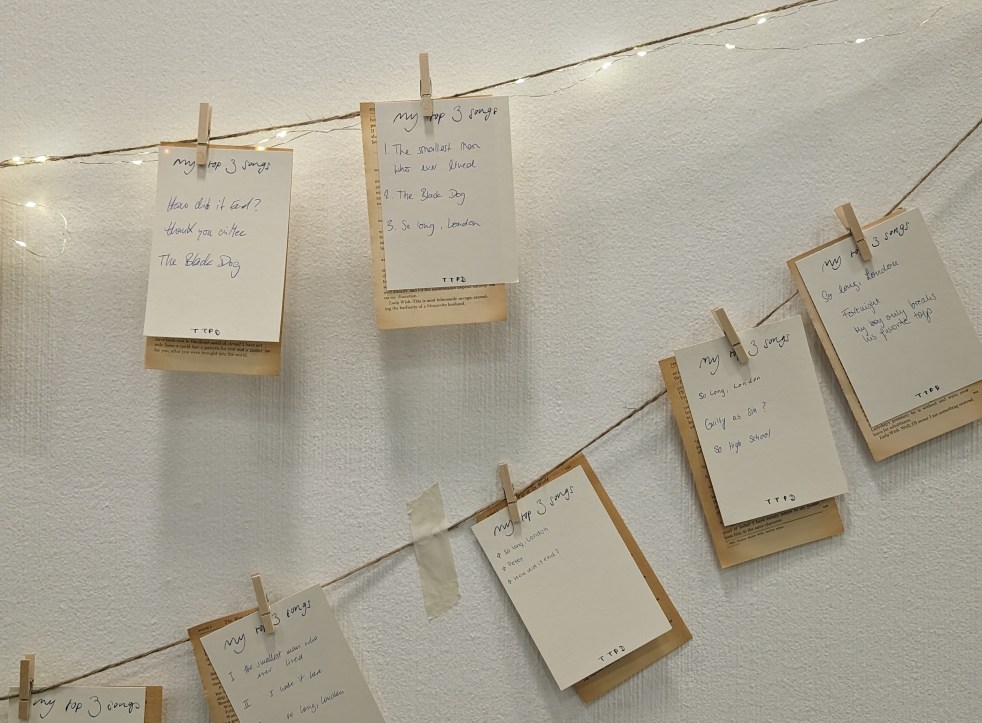
To cater to popular demand (two people asked me after a talk), I present to you a Taylored reading list inspired by every single song on The Tortured Poets Department, ‘The Anthology’. Yes, you can find TTPD-inspired reading lists elsewhere (I like this one, from the Rogers Public Library in Arkansas), but I’ve tried to go beyond the obvious (Dylan Thomas) and select appropriate reading recommendations for each song, plus a general list based simply on vibes (e.g. Dark Academia), which you can find at the bottom. I’ll keep this updated as I think of more recommendations, and please do add your own recs in the comments!
Fortnight: for what happens when they don’t forget to come and get a mad woman, read Jean Rhys’s Wide Sargasso Sea. It’s a compassionate and sympathetic retelling of the story of Bertha Mason, better known as the ‘mad woman in the attic’ in Charlotte Brontë’s Jane Eyre, and reflects on the position of women – particularly women of colour – in the nineteenth century. You might also check out a performance or film version of Tennessee William’s A Streetcar Named Desire, whose protagonist Blanche Dubois is carted off to an asylum for not conforming to ‘that 1950s shit they want from her’. For something less fictional, try Georgina Weldon’s The Outpourings of an Alleged Lunatic – Weldon’s husband tried to get her shipped off to an asylum once he had grown tired of her, and she spent the rest of her life trying to reform Britain’s ‘Lunacy Laws’.
The Tortured Poets Department: there’s a lot of mockery of the idea of the tortured poet here. For a much older tale that parodies the affectations of agonised romance, see Geoffrey Chaucer’s The Miller’s Tale, a bawdy reworking of a tragic love triangle into something rather less highbrow and rather more…flatulent. Or Henry Fielding’s Shamela, a satire of Samuel Richardson’s romantic novel Pamela. Or even Shakespeare’s sonnet 130, which makes fun of some of the clichés typically used by poets to talk about love.
My Boy Only Breaks His Favourite Toys: you may enjoy Jessie Burton’s The Miniaturist and Elizabeth Macneal’s The Doll Factory, both period novels that prominently feature dolls and figurines amidst thrilling plots of forbidden love and obsession. Or, for a much more drawn-out tale of masculine self-sabotage in its many forms, brace yourself for Hanya Yanagihara’s A Little Life.
Down Bad: for some original teenage petulance, check out J.D. Salinger’s The Catcher in the Rye, often thought of as the ‘first young adult novel’ by children’s literature scholars for its radically new, pessimistic and sweary approach to growing up, which stunned audiences of the 1940s. For some cosmic love, enjoy Philip Reeve’s Railhead trilogy, a futuristic story framed around an intergalactic rail network and a touching romance between a runaway thief and a cyborg.
So Long, London: it’s got to be Virginia Woolf’s Mrs Dalloway, set amidst a vividly-realised London on a single summer evening as the titular protagonist reflects on past love affairs.
But Daddy I Love Him: if we’re talking forbidden love, you might naturally turn to Shakespeare’s Romeo and Juliet. But consider, also, Arundhati Roy’s magnificent, Booker prize-winning novel The God of Small Things. Set in India, written in exquisitely rich language, it explores the ‘love laws’ that lay down ‘who should be loved, and how. And how much’.
Fresh Out the Slammer: Daniel Defoe (better known for Robinson Crusoe) wrote Moll Flanders after being inspired by a real-life criminal, Moll King, whom he visited in Newgate prison. It’s the tale of how the titular Moll tries to make her way in the world through a compelling combination of theft and her feminine wiles. You might also tackle the epic backpacker favourite Shantaram, by Gregory David Roberts, written during his own stint in prison.
Florida!!!: it’s not set in Florida, but Delia Owens’s Where the Crawdads Sing is the perfect combination of no-one asking questions, cheating husbands disappearing, and swamps. If Swift hadn’t already written ‘Carolina’ for the film version, I’d have assumed ‘Florida!!!’ was written for this novel.
Guilty as Sin: Lionel Shriver’s The Post-Birthday World imagines two parallel universes: one in which a woman gives into the temptation to cheat on her husband, and one in which she doesn’t. It’s the 600-page answer to the ‘what if…’ Swift asks in this song.
Who’s Afraid of Little Old Me?: since we should be, let’s look at a series of stories in which so-called ‘mad women’ take their revenge on the misogynist society that raised and then caged them. Start with Charlotte Perkins Gilman’s short story ‘The Yellow Wallpaper’, then progress to Wilkie Collins’s novel The Woman in White and finally Sarah Waters’s Fingersmith. You should also read Yaba Badoe’s A Jigsaw of Fire and Stars, which tells the story of Sante, an Ashanti heiress who grows up in a circus – and the life has certainly made her a force to be reckoned with.
I Can Fix Him (No Really I Can): novels where long-suffering women try to fix awful men are plentiful (why is that, I wonder?), but let me direct you to literature’s original Bad Boy: Heathcliff in Emily Brontë’s Wuthering Heights. Special mention, too, to her sister Anne’s The Tenant of Wildfell Hall and George Eliot’s Middlemarch, both of which document the struggle of women who desperately try to resurrect the fallen haloes of the men they once loved.
loml: it’s got to be Love in the Time of Cholera (‘littoc’???), Gabriel Garcia Marquez’s modern classic about two ex-lovers who rekindle their relationship decades later in their old age. Fermina has always been the loss of Florentino’s life; their reunion is poignant and touching and proof that it’s never too late. (Though it definitely is for the con-man addressed in loml – he doesn’t deserve a second chance).
I Can Do It With a Broken Heart: Gail Honeyman’s Eleanor Oliphant is Completely Fine and Amor Towles’s A Gentleman in Moscow are both, in different ways, uplifting novels about putting on a brave face over personal trauma.
The Smallest Man Who Ever Lived: pick up Charles Dickens’s Great Expectations. If Miss Havisham were alive today, I reckon she might have written this song.
The Alchemy: if we’re talking about forgiving the silliness of youth and embracing an inevitable attraction, David Nicholls’ One Day is the perfect choice. Be warned, though: the novel’s ending will leave you feeling rather less upbeat than the song.
Clara Bow: Taylor Jenkins Reid’s The Seven Husbands of Evelyn Hugo is perfectly suited to this song about the fleeting nature of fame and the desperate desire to stay relevant in the fickle world of celebrity.
The Black Dog: this song evokes A.S. Byatt’s Possession for me, especially the way it explores the observation and analysis of relationships from afar. There’s a particularly gut-wrenching scene that changes everything and hinges upon catching a poignant glimpse of someone you love but to whom you can never be close.
imgonnagetyouback: Gillian Flynn’s Gone Girl is the perfect combination of unhinged and lustful to suit this mad song about someone who doesn’t know whether to marry a guy or smash up his bike.
The Albatross: of course, it has to be Samuel Taylor Coleridge’s The Rime of the Ancient Mariner, from which the idea of the albatross as a fateful omen or punishment is taken. We might also add, in the theme of tempting women who may end up destroying a man, Madeleine Miller’s Circe, Bram Stoker’s Dracula, H. Rider Haggard’s She and Arthur Machan’s short story ‘The Great God Pan’. For more on locking women up in towers, read Alfred Lord Tennyson’s poem The Lady of Shalott.
Chloe or Sam or Sophia or Marcus: this song hinges upon historic miscommunication between lovers unable to say what was needed, when it mattered, which is the perennial theme of Sally Rooney’s Normal People.
How Did It End: hot-house flowers and outdoorsmen (and women) are central to Elizabeth Gilbert’s The Signature of All Things, a beautiful piece of historical fiction interspersed with plenty of botany in which the protagonist, Alma Whittaker, conducts a post-mortem of sorts for a relationship that ultimately eluded her, taking her from America to Tahiti and the Netherlands.
So High School: I’m going to direct you to the Twilight saga, the most high-school books about falling in love that I can think of. Or you could read some Aristotle, I guess.
I Hate It Here: the song seems to reference Frances Hodgson Burnett’s The Secret Garden, but I’d also direct you to two British postwar classics, Lucy Boston’s The Children of Green Knowe and Philippa Pearce’s Tom’s Midnight Garden, both beautiful stories about how lonely children find solace and comfort in a fantastical garden space. And there’s The Chronicles of Narnia, too, of course. For literature’s original idealised escape from reality, check out Utopia by Thomas More.
thanK you aIMee: this is a tricky one, but I’m going to direct you to Jane Austen’s Northanger Abbey, since it’s a perfect women’s novel that deliberately and vocally hits out at those who make fun of women’s novels. Austen’s popularity centuries later is sure proof that while they were throwing punches, she was building something.
I Look in People’s Windows: you might read Paula Hawkins’s The Girl on the Train, a murder mystery that hinges upon what protagonist Rachel sees through a house window from the train on her commute every day. I’ll be honest, I thought it was an awful book, but it seemed to grip a lot of people, so you might enjoy it too.
The Prophecy: the frustrating machinations of fate and destiny are at the heart of Philip Pullman’s classic and magnificent His Dark Materials series, and you might also consider Audrey Niffenegger’s The Time Traveler’s Wife, which deals poignantly with the frustration and heartbreak that comes from knowing the future (and the past). Or Nikki Erlick’s The Measure, which explores how people react when they find out the exact length their lives are going to be.
Cassandra: cursed to have no one believe her when she uttered true prophecies, Cassandra might be the symbol of many women throughout history whose voices were never heard. Poet Carol Ann Duffy lets us hear them in her collection The World’s Wife, which tells the imagined stories of, among others, Mrs Icarus, Mrs Darwin, Mrs Herod, Anne Hathaway and Medusa. You might also read Virginia Woolf’s ‘A Room of One’s Own’, which meditates upon all the women left out of history via a thought experiment about Shakespeare’s sister.
Peter: well, it has to be J.M. Barrie’s Peter Pan. You may think you know the story from Disney and popular culture, but you might find the novel – based on what was originally a short story and then a play – rather darker and more problematic than you expected. If you want to continue down this vein, read Jacqueline Rose’s book The Case of Peter Pan, one of the first books of children’s literary theory and still somewhat controversial.
The Bolter: I recommend the rather lovely What I Carry, a young adult novel by Jennifer Longo about a girl who has lived her entire life in foster care, bolting from one home to another to avoid getting too attached. You could also read Edith Wharton’s excellent The Custom of the Country, in which wonderfully unlikeable protagonist Undine Spragg flits from one dalliance to another, never satisfied financially or emotionally. This is also the theme of William Thackeray’s epic Vanity Fair.
Robin: read William Wordsworth’s poem ‘Intimations of Immortality from Recollections of Early Childhood’, which nicely encapsulates the Romantic view of childhood innocence and how growing up is a steady entry into the ‘prison’ of adulthood – an idea still very much present in Swift’s writing today, and wider Western conceptions of childhood.
The Manuscript: this poignant meditation on self-knowledge, growing up, writing, independence and reflection is made for Charlotte Brontë’s Villette, my favourite novel. It also evokes, for me, Elena Ferrante’s Neopolitan Quartet, a gorgeous series of novels that constitute the ‘manuscript’ of the narrator’s published life.
General vibes of the album: tap into the ‘Dark Academia’ trend with Donna Tartt’s The Secret History and M.L. Rio’s If We Were Villains. Get your tortured poetry fix from William Blake, Emily Dickinson or Sylvia Plath. Let someone else get to tell you about sad with breathtaking novels about grief like Maggie O’Farrell’s After You’d Gone and Helen Macdonald’s H is for Hawk.

 Swifterature
Prof. McCausland nailed it this academic year. If anyone had doubts…
Through Swifts texts she made a connexion with,mainly, femenistic English literature throughout time. What a journey.
Inspiring … Got my reading list ready and will be sweet for some time.
Congratulations, proud to have you in Gent professor, and also curious what will bring next academic year in your department.
When it comes to tortured poets, I am a little bit surprised that the Grand Dame and tortured poets-archetype Anne Sexton and her splendid work, did not get any attention. Maybe I missed something here ?