
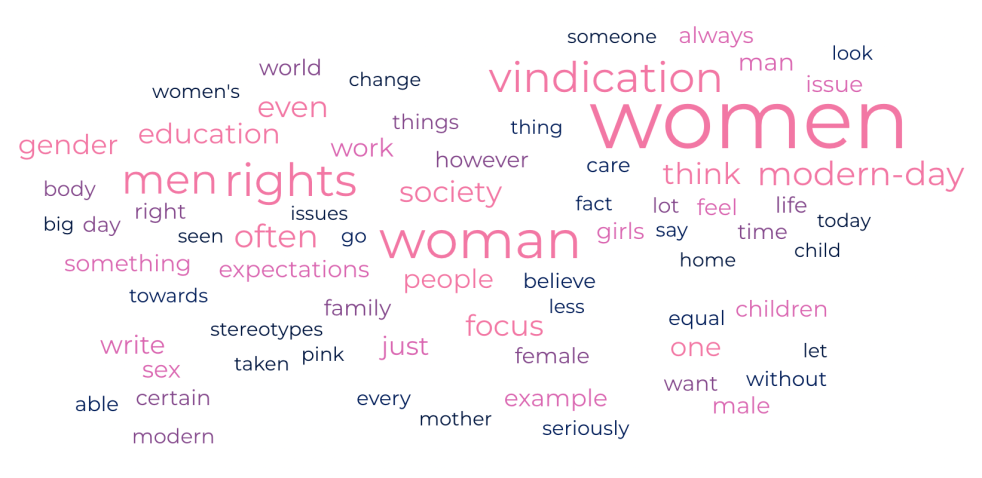
As part of our session on feminism, writing and power, we looked at Mary Wollstonecraft’s seminal ‘Vindication of the Rights of Woman’, a 1792 treatise that argued for the importance of women’s education during a period where it was habitually denied. Expected to be little more than delicate parlour ornaments, women were not seen as worthy recipients of the kind of education offered to men – a state of affairs which Wollstonecraft laments, while pointing out its idiocy (surely men would prefer a wife with whom they can hold a conversation). As a thought experiment, I asked my students: ‘If you could write a modern-day “Vindication of the Rights of Woman”, what feminist – or gender-related – issue would you focus on, and why?’ Here are some of the responses – you can also see a word cloud of the most frequently used terms above. They are powerful, moving, hilarious, infuriating and, above all, inspiring. I’ve tried to group them into rough categories. Click on each snippet to read the rest of the post.
Sex education, sexual health and victim-blaming
The primary subject I were to focus on would be the right to sex education and sexual health.[read more]
The sex education I experienced in secondary school was quite miserable. The courses focused entirely on the biological aspect of sex and approached sex as a scientific matter, only valuable for reproduction. As a 16 year old, this was not what I needed and i expected more from my teachers.
Another domain in this society where an incorrect image of sex is given to the younger generation is through media, films, and porn, where often a heteronormative and male-dominated perception of sex is reflected. Since this is in most cases the only acces teenagers have to ‘information’ on sex, an incorrect and unhealthy image is formed, which could be countered by education.
I believe that in this patriarchic society education on sex and their sexual rights would benefit all women. I would like to highlight some examples that would be part of this education: the way porn displays sex should not be considered representational; sex is more than penetration; each person defines for themselves what sex can be; consent is of utmost importance for all parties involved and all parties are allowed to say no whenever they feel their boundary is crossed and there should be listened to this; boundaries are there to be respected; communication makes the experience pleasant; the importance of consent should not disappear in marriage; sex doesn’t have to be serious all the time, it can be funny or awkward and many other things; … These are just a couple of topics that should be included in the sex education women have right on.
Related to the stated above, women should have the right to be taken seriously regarding to sexual offences or intimidation. These offences get often dismissed in court, or the perpetrator gets a minimal sentence. As a result of this, informing the police or a trust person is a very big step and victims are often scared to do this. Which could be partly avoided if this right was respected.
If these statements would be accepted as general rights for women, this would mean a first step to more (sexual) safety and more pleasurable and healthy sex for women.
To me, prejudices against women are still omnipresent. I think they are internalised for women as well. If I were to write a modern-day ‘Vindication of the Rights of Woman’, I think I would focus on the large issue of victim-blaming of assault victims.[read more]
Often, reactions of people after someone comes out to say they have been assaulted, are not supportive. This is an issue that can happen with all genders, however I think it is more prevalent with women. Reactions like ‘What was she wearing?’, ‘Was she dancing provocatively?’, ‘Sometimes it is hard to tell if she wants it or not’, ‘Did she let herself go and get drunk?’, ‘Why was she walking alone at night?’ are some examples of victim blaming. I find it frustrating that it is always the women who have to take precautions to not get assaulted instead of teaching the men to not do it. This is a very generalising statement but it sometimes feels like this. It is frustrating that we can’t walk alone in the dark, that we should not wear really revealing clothing etc, just in case someone bad decides they want to hurt you. I recognize that you should be cautious because there is always a chance that someone wants to hurt you; I don’t go walking in the middle of the night. But it’s just stupid that it is a fact we have to think about.
A lot of assaulters also do not get punished appropriately which makes it more difficult for victims to come out and say they have been assaulted. I feel like there just is too much of a focus on what the victim could have done to avoid it and not enough focus on what society could do. I think changing this is something that would take great effort because the patriarchal mindset goes a very long way back, but I think it’s a necessary thing to do.
Reproductive rights & choices
It’s the constant questions women in their 20’s and 30’s especially get from others: “Do you have a boyfriend yet?”, “When are you getting married?” and worst of all, “when will you have kids?” That last question in particular is one that makes my skin crawl. Not only because it is a private matter, but mostly because of the follow-up remarks when the answer to the question is: “I don’t want kids.”. “Oh you’re still young, you’ll change your mind.”, “You just wait.”, “But … why?” are just a few of the many (many, many) comments that always seem to follow.[read more]
I firmly believe that it is every woman’s personal choice whether they want kids or not. There can be an array of reasons why someone would or wouldn’t want kids. That is completely up to them. Yet, not wanting kids in this society seems to be a big no-no. Especially for a woman. My male partner or friends have never been asked ‘the kids’-question nor was their decision questioned if they ever mentioned not wanting kids. As a woman, however, I get those questions quite often, even from people I barely know and the comments that follow are always telling me how mistaken I am.
I would start off by extending the vindication to the rights of non-binary people as well, stressing the freedom of gender identity and gender expression however the individual feels comfortable. I would also emphasize the inclusivity of trans women, as their rightfully equal status is unfortunately still not self-evident in every place of the world.[read more]
I would advocate for female reproductive rights, allowing women to decide what happens to their bodies, encouraging the legalization of abortion in places where it is not yet – or no longer – legal. I would also advocate for equal treatment in the workplace, eliminating any possibly still existing pay gap. Furthermore, I think it is important to focus on societal expectations of women, as so many women and even young girls are exposed to unrealistic beauty standards, causing body image issues and issues related to self-esteem. Additionally, I think it is important to advocate for letting girls be girls, teenagers not having to feel like they have to “grow up” and adhere to any expectations of being a woman that are being projected onto them.
I would write about the importance to have the right to have an abortion, and thus to have autonomy over one’s body.[read more]
Last year, the overturning of Roe v Wade caused a lot of commotion. The US Supreme Court ended the constitutional right to have an abortion, which means that the individual states can decide whether they implement restrictions or bans. The Supreme Court exists of nine judges: six men and three women. Five of these judges voted in favour of overturning the law, four of these were men. Four men and one woman took away the choice of all American women to decide what to do with their body. They took away the autonomy women have over their own bodies. The choice to carry a child should be the woman’s, not a man who cannot carry one and therefore cannot fully comprehend what a woman goes through during pregnancy and labour.
The child also needs a good home once it’s born and not everyone can offer that, and so many children end up in foster care or worse situations. To bring children into this world and being unable to offer them anything but misery because of your resources, is in my opinion worse than a medical procedure. Another important thing to remember is that it is much easier for the father of the child to walk out. Already during the pregnancy, the father has the option to leave while the woman cannot, as the child is growing inside her. Men do not carry their child for nine months, and so may feel less responsible for the baby which makes the decision to leave easier on their conscious.
Moreover, the whole pro-choice-pro-life debate and the overthrow of Roe v Wade may feel very American, though in my Vindication of the Rights of Woman, I would obviously argue for women everywhere. No woman should be obligated to carry a child if she does not wish to do so. The people claiming to be pro-life do not truly care about life, seeing as they do not particularly care about what happens to the child after it is born. Pro-life people do not protest for better foster care, the children separated from their parents at the border, or the children that are killed during school shootings. If one truly cares about life, they would advocate for laws to better protect grown children. To be pro-choice on the other hand, means to give women the option to choose what happens to their body. It does not mean, you necessarily agree with the act of abortion morally, but you realise the importance of autonomy over your own body, and you agree that every woman must decide for herself whether or not to keep the child. A last very important note is that to forbid something does not mean to eradicate the existence of it. Women have in the past and will in the future get abortions. The prohibition of the right to abortion means that women must look for unsafe options, risking their own health because the safety of the hospital is no longer available to them. In the year 2023, it should be a given that women have complete autonomy over their body without male (or religious) interference.
Unpaid labour and the mental load
I would focus on how women should not be compliant while they (subconsciously or not) enable men’s reliance on them and high expectations of them. Especially coming from an immigrant background, I feel like I have a first-hand experience on how men in the family are raised to be absolutely useless and helpless when it comes to “household work” like cooking, cleaning, helping with the children, etc. [read more]
I vividly remember being around ten-years-old and asking my mother why I have to clean up the table after my male relatives come to visit us while these grown men don’t even do as much as lift a finger to help bring their plates to the kitchen, which is only like 2 meters away. I also asked her why she would let them say things such as: “The food could be better seasoned” after cooking for hours by herself, as if she’s a maid. While my mother is an intelligent and lovely woman, in my opinion 😊, I do feel like she, like many other women in my family, often enables the men in our family to stay incompetent (which, I think, stems from her own upbringing which was heavily influenced by my late grandmother). Whenever I rant about men’s incompetence to her, she just responds by saying: “Well, I simply don’t mind doing that (things such as cooking and laundry) for them… They simply weren’t taught anything and it’s too late to change it now.” Afterwards, she often spins the conversation to the fact that she thinks that I’m being too individualistic (just like western society in general, according to her) and that I wouldn’t do anything for anyone unless it were to benefit me. Unfortunately, my mother is not the only one who thinks like this. Even in western society, I’m sure that there are still people who heavily embody this mindset. It’s just that I feel like the women in my community often raise their sons to only work, eat and sleep, without expecting them to lift a finger in the household while simultaneously pressuring their daughters to consistently help so that they can eventually be great wives later in life. The aided incompetence of men in the household would thus be my main focus if I were to write a modern version of Wollstonecraft’s revolutionary oeuvre.
Legal rights
I think in an updated ‘Vindication of the Rights of Woman’, our focus should extend beyond our borders, to those who remain voiceless, addressing inequality in countries and societies where woman is far from being seen as equal to man.[read more]
Iran serves as a striking first example of the systematic suppression and restricted freedom women endure on a daily basis under the regime. Strict laws forbid women to express their opinions, enforce heavy censorship and clothing rules – to wear a hijab and loose concealing clothing – and in general prohibit women from living a life without their husband’s permission. To ensure compliance with these laws, a strict morality police, established in 2005, constantly monitors women to ensure they follow the imposed rules and dress codes, highlighting the deeply ingrained gender inequality in the country.
Afghanistan provides a recent and perhaps even more alarming example on how the reversal of women’s rights is also a reality. Since the Taliban’s takeover, there has been a return to the pre-2002 era of gender segregation and restrictions on women’s movements and rights, depriving them of fundamental rights including freedom of speech, education, employment and mobility. Furthermore, they face limitations in accessing public spaces like amusement parks, public pools and sports clubs, coupled with restricted participation in the workforce, politics, and the legal world. The enforcement of strict dress codes further underscore the extent of this alarming shift back to the past.
In a modern-day ‘Vindication of the Rights of Woman’, let us celebrate our achievements, and meanwhile look beyond our own experiences and refocus our energy on helping those who remain voiceless, and advocate for women’s rights worldwide.
“For many women across the world, walking out your front door is an ordinary part of life. For many Afghan women, it is extraordinary.” – Mona Chalabi
There is probably nothing that enrages and frustrates me more than realizing that somewhere on this planet, an intelligent and strong girl is wandering around who is capable of changing the world which we live in today by becoming a powerful doctor, lawyer, artist, etc. but is restricted due to poverty or the patriarchal system.[read more]
Personally, I have never quite understood why I and my fellow female students, for instance, are so lucky to be able to obtain a basic education, get the opportunity to enroll in university, and – hopefully – find work and contribute something meaningful to society, while somewhere further away from us, some poor girl, who has been gifted with qualities and skills akin to mine, is not even allowed to take classes or finish high school because of her sex. This downright sexist and discriminatory attitude, which still unfortunately reigns in countries such as Afghanistan, saddens me to my core, since I cannot fathom why grown men feel so intimidated by women going to school and obtaining a degree in something which they are passionate about. Following Mary Wollstonecraft, I would thus focus on the education of young girls and women all around the globe if I ever were to write my own version of A Vindication of the Rights of Woman, because in the long run, exclusion from education merely due to gender will never benefit anyone – not even the men who set up and actively or passively support this way of thinking and living.
Intersectionality and inclusivity
A Vindication On The Rights Of Women in this day and age would have to focus on intersectionality, in a way the original text didn’t. Firstly, it would have to focus on different classes. [read more]
The original text posits itself firmly as middle-class and, somewhat harshly but not completely unfairly, criticizes the upper class. Furthermore, the text fails to incorporate the lower classes in a progressive and compassionate way, only making exceptions for the ‘intelligent’ and retains class distinction. A modern-day text would have to incorporate all classes, and underline the struggles and obstacles still present in the inaccessibility of education for lower classes, as well as the structural usage of inaccessibility of education by the upper class to retain power. Moreover, a modern-day vindication wouldn’t limit itself to intersectionality in women’s education but would open this up and use it as a lens to inspect all aspects of society. Too often when talking about feminism in the West we are thinking of one type of woman: white, cishetero, pretty, gender conforming. If we want to tackle misogyny, we need to realize that although being women binds us, that does not mean we get treated equally in certain situations, and that gender is just one category that interacts with other categories such as class, race, sexuality, (dis)ability, religion, culture, etc. A Modern-Day Vindication would have to strive towards being as inclusive and intersectional as possible in every aspect we can think of.
Stereotyping and prejudice
So what if read Villette in a bedroom with pink walls underneath pink sheets adorned with flowers? I also drag around carts full of heavy beer crates wearing steel toe boots during the weekend and probably know more classic rock songs than your middle aged dad. In many cultures, the line between what’s considered feminine and masculine has already started to blur and interests and occupations are often no longer reserved for a single sex, even when it is still primarily linked to one. However, being tolerated and being accepted are two different things.[read more]
Even in the last few weeks I’ve heard several times that a “delicate doll” like me has to be more careful and is less able to perform certain tasks compared to a man, even though we have the same amount of training and experience. This probably wasn’t meant to be derogatory and more in the sense of “knowing your own strengths and weaknesses”, but the connotation of terms like this or any similar stereotype is limiting and assures the survival of gender biases.
Since language is a representation of how we see the world, equality between men and women start by removing language like this via education. Not only the education of woman, but of men as well so they can appreciate and respect the diverse interests, strengths, and capabilities of individuals regardless of their gender. True acceptance means recognizing that everyone should have the freedom to pursue their interests, regardless of whether those interests align with traditional notions of femininity or masculinity. The only thing to keep in mind once this language has been removed and woman are spoken of as equals, is to actually act upon these words. Because no progress has been made if you talk about how women have the opportunity to get an education and advance in theirs careers when in reality, which is often still the case, this isn’t true.
Talk about woman as equals and then practice what you preach.
I would focus on societal expectations of women. Women are often taught to present themselves a certain way, to express their opinions but to always be respectful, to not be too loud, to want certain things (family, marriage, etc), to dress a certain way, not too modestly or you’re a prude but not too revealing or you’re a slut. [read more]
I think women are judged too publicly, suddenly it’s everyone’s business. And that judgment is too often focussed on their appearance, often also resulting in (over)sexualisation. I think it’s sad that as a girl you get catcalled regularly, some men give you slimy compliments but when you say no you’re a bitch, if you express you’re uncomfortable in that situation, you’re overreacting. Too often when women are expressing boundaries, they are seen as “overreacting”. “You’re so sensitive”, “Are you on your period?”, “You’re acting crazy”. These really make my blood boil. When you complain to certain men about this issue, they feel attacked because not all men are like this. Of course not all men are like this! (thank the lord) But this should not mean women cannot express that this is still an issue. I think something is really wrong in society if as a girl, you feel scared going home alone at night, that you always say to your friends “text me when you get home!”, “be safe!”. And that that is so normal we sometimes joke about it. Most parents often tell their daughters to be careful, but some don’t tell their sons enough that women are human beings, regardless of what they’re wearing. No outfit is an invitation if no consent is given. The main issue is that this behaviour is validated since ‘boys will be boys’.
I think there is also a problematic tendency with regards to housework, still today women are often expected to do a lot of the household tasks, which is often due to how they were brought up (especially in certain cultures). Girls are taught to cook, to do laundry, to do the cleaning whereas boys are not really expected to know these things. This sometimes results in something called ‘weaponized incompetence’, where men say they don’t know how to do something or do it badly on purpose to avoid having to do it in the future. Or they right out say housework is ‘women’s work’. However, the problem is not always so on the nose, sometimes men ask their partners if they can ‘help’ with something (and expect to be thanked profusely for doing the dishes once). She knows what goes on with the housework, and he helps which places the responsibility on her to stay on top of it and ask for help. Of course this is not always the case, and every couple can work out what works for them, it’s just that certain societal expectations, clichés and certain ways of upbringing can result in these problematic tendencies.
In my vindication of the rights of woman, I would argue for an abandonment of these stereotypical expectations and views. Men and women should be treated as equals and work together. We should let go of an ‘us’ vs ‘them’ mindset, especially in the upbringing of children. In the end we are all people.
The problem of unseriousness towards women. I worry that as a woman, you don’t get taken seriously in every situation. It can be very hard for women to enter male dominated industries without being met with much difficulty and facing some hardship.[read more]
The example I was thinking of is the (video) gaming industry. Inclusivity has much improved in this male-dominated landscape, but there still are some challenges women face. There are a few examples where women have to deal with unserious attitudes. Gatekeeping, for instance. If you are a girl, people tend to need ‘proof’ to see if you are a “real gamer” and are not just involved for attention rather than genuine interest. Another example I can think of is streaming, where girls sometimes have to deal with unwanted (inappropriate) comments and quickly get called -too often used- names. A third example is that when you play online, in some games you are put in a lobby with other players randomly. Some girls don’t like turning on their mics out of fear of being treated differently during the game, getting unwanted attention and having to deal with the assumption that they might play bad. This could affect their performance and just ruins their fun in general. One more thing that could contribute to the way women are viewed in this industry, is the way females are represented in games. The overly sexualised woman in GTA or the damsel in distress (Princess Peach in the Mario series for example) draw upon stereotypes that could affect women negatively if they are not also contrasted with more progressive views.
It will take a coordinated effort by the gaming and streaming industries, companies, developers and gamers themselves to address these challenges and encourage a more welcoming and supportive environment for women in that (mostly) male-dominated industry. (I did a quick Google search and there are nearly as many women playing video games as men. To keep up with the realities of this industry, an attitude shift and change is required!)
Now that I’m thinking about it, women not being taken seriously in the gaming world kind of relates to how women are treated in the entertainment industry in general (?)
My focus would be on how women today face challenges to act as the primary and sole protagonists of their own stories, free from male interference. Because in today’s world, it’s heartbreaking to see that women’s actions are still often unfairly tied to men, with their intentions and worth constantly being judged in relation to the opposite sex.[read more]
Women’s appearances are constantly analysed and judged, with many assuming that women must dress up or look beautiful primarily to attract men. Look for example at how Taylor Swift is often treated by interviewers. Instead of celebrating her talents and achievements, discussions often revolve around her love life. When she looks stunning on the red carpet, it’s often assumed that she must be trying to catch the eye of a man. This problem not only affects Taylor Swift but affects many women on a daily basis, including me. I, for example, face similar assumptions when I choose to dress up or wear make-up. It’s like society seems to automatically link these choices to the desire for male attention. This makes me believe, and I think it’s a sentiment shared by many other women, that we often feel powerless over our choices and struggle to express ourselves without the perception of needing a man.
When will women be allowed to be the main characters in their own lives, free from the constant association with men? I strongly believe it is high time for change. I and every woman should be able to dress up, wear make-up, or make choices based on our own pleasure and self-expression, without it being seen as a strategy to impress anyone but ourselves. We as women should be free to define our lives, style, and choices without the constant gaze of male expectations. We deserve the chance to live independently. By breaking free from these outdated stereotypes and expectations, we can work towards a world where women are celebrated for who they are, not for how they might relate to men. Only then women would be able to take the lead in their own lives/stories.
We still have a long way to go until the rights of men and women are completely equal. We will have to make an effort as a society to attain this objective but meanwhile, there are things we can do as individuals to improve this. I want to focus on one aspect that men could try to implement in their daily life: respect, value and listen to what women have to say. Let’s talk about mansplaining![read more]
Mansplaining is a compound of the two words: man + explaining. Men often try to explain things/ situations to women as if they were stupid or ignorant. Although this is a “minor” action, it happens in everyday situations, and it feel very condescending for women. It is simply irritating and unnecessary. So, today, I am asking men to, please, stop talking down to women as is they were children. This will be a big step forward because if men can see women as equal in their day-to-day interactions, it will be easier to implement the rest such as equal salary, job positions, women feeling safe etc.
“Women can do anything if they set their mind to it” is a phrase that many young girls are growing up with today, and while it is certainly a step in the right direction, we are not there yet; this phrase, while empowering, still implies a struggle on the woman’s part. Achieving something as a woman takes a strong mind, hard work and a lot of willpower, is what it is saying. And sadly, this is still true. Even in today’s society, women constantly have to prove themselves to be taken as seriously as a man. [read more]
As a woman, you have to be more resourceful, work harder and be smarter than any man you are up against to be even remotely considered his equal. You cannot have any “girly” interests as a woman in power, or you will be considered silly and unserious. You are not allowed a single slip-up. And that’s why I am advocating not only for women’s rights, but also for women’s wrongs. For a world in which women can be mediocre and still be taking seriously. A world in which women are allowed to make mistakes without compromising their entire status. A world that is truly equal.
The ‘pink tax’
Our society is built on capitalism and making as much profit as one can. Hygiene products, clothes, other goods and services are not exempt from this rule. Research has shown that women spent up to 200,000 dollars more than men on similar products and services in their entire life. This is due to the pink tax, a markup on certain products or services targeted towards women, while men pay less for similar goods or services. [read more]
I think it’s absolutely absurd that women have to pay more for shampoo, soap, razors, hairdresser’s appointments or clothes just because they are targeted towards women. Often times the female and male products are identical, only the packaging and the prices are different. As women still earn less than men on average (gender wage gap, glass ceiling, traditional gender roles and jobs…), forcing them to pay more for products targeted towards them is so unfair. Paying more while earning less makes it way harder for women to become more financially independent. It can therefore be linked to the patriarchy and wanting to force women to stay dependent on their male counterparts. It also just feels like a scam to pay more for a product just because it’s targeted towards women.
Obviously, nobody is forcing women to buy the more expensive products targeted towards them. They could buy the men’s version of the product and no one would bat an eye. I’ve bought male razors before just because they’re cheaper and no one cares, so why make it an issue? My issue is that many women will pay for the more expensive female product, as they feel like they cannot buy the male product, as it wasn’t made for them. It’s so normalized for women to let the binary construct of gender and male supremacy force them to make decisions that hurt them. Therefore, I think it’s time we do something about the pink tax and introduce tighter legislation related to product prices, for example.
If we are able to illegalize the pink tax, many people would say this would be bad for the economy. Stores would make less as the prices have gone down. Now to counter that, I’d say that allowing women to pay the same amount for products as men, leaves women with more money to spend on other things. Furthermore, making female-targeted products more affordable would encourage more women to buy them as well. So illegalizing the pink tax could actually be beneficial to the economy.
Long story short, it’s a bad time. Long story short, we haven’t yet survived. These were just a couple of reasons why I think the pink tax is stupid, misogynistic and should be illegalized. It would be another step in the right direction. Sadly, I don’t think it’ll happen anytime soon. So in the meantime we should keep on spreading awareness about the pink tax in the hopes that the future generations won’t have the same problem any more.
(Almost) all of the above!
And welcome back to the latest episode of “Don’t get me started”. Today we’re going to talk about women’s rights, which I will attempt to do in layman’s terms, so that everyone can understand it.[read more]
*Note: I am mostly using the term women, but I acknowledge similar issues that people afab and people MtF have as well.
** Trigger warnings: contains sexual abuse and mentions of other types of violence, eating disorders, body dysmorphia
If I were to write a new vindication of the right’s of woman, I would certainly run out of space, as much as men have run out of breast synonyms in their novels. For this reason, I will solely focus on 4 main points.
1) Reform of education all over the world (DECENT EDUCATION)
Biology class: There is a real reason why people are able to draw dicks on every building, paper and anywhere else, because yes, the female body is and has been a still rather unexplored mystery. Whether it’s doctors (male, female and every other gender) not believing women and afabs about their bodily experiences, about the continuous lack of information about their own bodies (anatomy, consequences of certain anticonception, safe ways to have F-F sex, I could go on quite some time) and disinformation due to extreme religious groups (think of the US and how women are not told truthfully how abortion works). Even more, there was an article by Schamper a little while ago, that reiterates the dangers of not taking women seriously + women not being informed themselves about how different heart issues feel in comparison to what men feel. Another thing that’s truly lacking, is consent culture in education. In biology, and we’re the lucky ones in Europe with relatively okayish sex-ed, we mostly get information about bodies and the reproduction function of our genitals. Rarely or ever is that also focused on the emotional part of sex, on consent, other types of relationships and queer sex. It’s not that hard to understand that so many women don’t report sex crimes if they don’t get what can be defined as a crime in the first place. People tend to portray r*pe as something that happens in dark alleys by creepy strangers, but rarely is it ever stated that most sexual abuse is by the hands of someone close to you, even loved ones.
P.E.: in PE, there’s almost always some difference as to the exercises boys and girls need to do, which is fine because there are indeed biological differences between the different sexes. However, it is so often the case that girls are told they can do the ‘easier’ exercises. The way in which the differences are emphasized is really wrong and contributes to girls feeling weak, the lesser sex and the boys mocking us/being annoyed they need to do the ‘harder’ exercises and so on. Sports are also still very gendered. For example, I often had to do dancing and was more pushed in the gymnastics part of class, than for the ‘rougher’ sports. This all contributes to gender stereotypes and is highly harmful for trans* people as well.
History: in history, oftentimes the focus is on big events such as wars, and important figures. These important figures are very often male, and, moreover, if there are some female examples, it’s very likely to be almost unattainable heroine type of women such as Joan of Arc, Amelia Earhart or Pocahontas. In my high school I was lucky enough to see some of the suffragettes movement, but it’s still not nearly enough. I want to know about female resistance, about queer relationships in Greek, about everyday heroes of the last decades.
=> Since I could keep going on, I will end this part here, because I could honestly reform the entire system in writing, but that would take ages to write (and for you to read). There’s really a lot of things to unpack here, but educational reform is really a must to just change the mindsets of the people who will run the world later on.
2) Woman’s fashion + other products (DECENT CLOTHES, NO MORE PINK TAX)
Fashion, although it seems like a woman’s world at first, is one of the main contributers to eating disorders all over the world, while all part of the male gaze as well. Women continously need to look thin enough (think of Lily Allen’s “You should probably lose some weight, cuz we can’t see your bones”– Hard out here for a b*tch), but still have baby-bearing hips, big perky tits and a bubblebutt. We should have big eyes, but too big is scary and too small is ugly. Big lips, but not like a fish. We should be dressed up, but not too much cuz that’s intimidating, but not too little or you’re a hobo. Have long legs, but for heaven’s sake, don’t be larger than your boyfriend… but do wear heels, because it makes your butt look better and elongates your legs, but don’t forget to shave them because who wants a cactus, amirite, but don’t spend one hour getting ready because time is precious “and I don’t want a posh barbiedoll gf”. Either way, it’s very hard to do well for everyone, especially with so much male gaze. Oftentimes this contributes to body dysmorphia, which is great for both the fashion industry, the diet industry, psychologists, pharmacists, surgeons who perform gastric bypasses, sports industry (#BridgetJonesWasNeverFat) and so many more… somehow.
Further, although high end fashion, and to some extent fashion of daily life, is becoming more genderfluid, it is still a very problemat thing. Many items are still made for women, by men, and it’s very clear in the lack of functioning that certain items have. Think for instance about the many MANY pants that women have with either no pockets or fake pockets. Somehow, women are forced to wear purses or bags even for the smallest amounts of items, AND THUS PAY MORE (in this economy????). Women are often told their legs need to be pretty, thus we are told to shave (hello pink tax), wear heels (hello foot pain + joint issues, and bras that are often made pretty but feel as stabbing cages instead of comfortable support wear. Somehow, most comfy bras are ugly as heck, let alone bras for people who have breasts bigger than a D cup. Women are a very big victim of capitalism: decent menstruation products are expensive and have pink tax, shaving, jewellery, hair treatments cost more, perfumes, makeup, pretty lingerie, sports lingerie, every day lingerie, extra bags because no pockets, extra clothes because ‘just a t-shirt and jeans’ is often seen as ‘you didn’t even try’, and so much more. It’s really ridiculous, and no, of course men have it hard, because somehow all the items for men are tech and very expensive, but the basic means are expensive too, for so many women. We shouldn’t have to choose between a phone (helps to find work, to keep in touch) and menstruation products.
=> Capitalism feeds of taking away basic needs and suggesting ‘needs’ that are actually ‘nice to haves’, just for the sake of, you guessed it, profit.
3) Healthcare (DECENT BASIC HEALTHCARE)
As mentioned above, healthcare is still very much an issue for women and afab people. Women are often questioned when they express their concerns or pain, they are often not given access to the right meds or the right treatment, black women’s pain is notoriously dismissed with the ‘strong black woman’ trope and so on. Overall, healthcare is still very male-oriented, male doctors are also taken more seriously and women are often pushed towards ‘female fields’ (gynaecology, nursing, pediatrician). Even more, women have different needs than men, but do not get more out of their health insurance funds. Women are often seen as weak, and thus will push through their pain, their illnesses, and might even tell their daughters to do the same in the sake peace and quiet instead of society scolding them, disbelieving them and mocking them. Moreover, during pregnancy, many women are dismissed (even more) due to being too emotional, which is utterly disgusting.
=> Overall, a good reform of healthcare, should insure that women get the help they need, the financial compensations they need, that they are believed and decently taken care of. Healthcare is a basic right, and even that is so unevenly distributed amongst people, either due to gender, sex or financial/social status.
4) Safety, jurisdiction, law enforcement (DECENT BASIC SAFETY, LAWS)
The entire #metoo campaign has shown just how ugly things can get when women try to be honest and stand up for themselves. Instead of people, and also more particurlarly law enforcement, believing them, they are asked why they waited so long to come forward, they are asked for physical proof of their bodily violations, even when so many violations don’t have proof except for the mental health issues that are born from it, they are asked to relive the same trauma over and over again, just to hear that another person gets away due to lack of evidence or because the crime has a limitation period.
=> It should be logical that women, as much as men, should be heard, that there is more help for victims in thoroughly guiding them through the process and that ‘proof’ should be so much broader than bodily fluids and bruises. That text conversations with vague threats are taken seriously, that dickpics can be seen as online sexual harassment also in all the laws everywhere, and that there’s a much broader protection against revenge p*rn and revenge leaking of n*des.
To conclude, we still have long way to go, but I believe that the newer generations are already more eager to defend themselves, are more aware of consent culture and gender bias, and I thoroughly hope to see more and bigger change in the rest of my lifetime.

 Swifterature